

Day #29 - Your Turn
You have heard a lot from me in the last 28 days, I’d love to hear from you.
This is your chance to tell me anything related to yoga or not…
Like this PEE SAFE bottle, I found it in the chemist… only in India!
You have heard a lot from me in the last 28 days, I’d love to hear from you.
This is your chance to tell me anything related to yoga or not…
Here are some ideas to write on…
What you enjoyed the most about the post from Pune.
Something you learned this month you are excited to take on board
An asana or two you are going to try
Your biggest struggles with your practice
Anything! I can’t wait to hear from you.

Day #28 - Index Poses
The phrase Index pose has been repeated often this month.
Have you heard this term Index Pose?
I instantly knew what it was, but had not heard this phrase before.
The phrase Index pose has been repeated often this month.
Have you heard this term Index Pose?
I instantly knew what it was, but had not heard this phrase before.
If you are not sure I’ll tell you my understanding of the phrase Index Pose.
They are foundation poses, the simplest asana that teaches us the base for the more advanced version of the asana.
‘Index’ is defined in the dictionary as - is an indicator, sign or measure of something.
In trying to better understand what this index poses concept is my right and left brain are in conflict.
The left brain wants a list of pose and a linear trajectory.
My right brain dismantles and challenges anything my left brain attaches to.
I want some direction, but I also want freedom and this is important in this post.
I do not want to say index pose for this asana is this and that is the end of the story. Index poses like yoga can’t be fixed.
But I do want to give some examples to give you food for thought.
Here are a few gross examples.
Virasana could be the index pose for Ardha Matsyendrasana.
Prasarita Paddotanasana could be the index pose for Sirsasana II
Do you see the link?
As a teacher, this is kind of 101 when it comes to sequencing, I’m just excited to have a label for it.. to put on my box:)
Teacher of not, knowing the index poses for more challenging asana is going to be crucial for your development as a practitioner because they are the foundation and without the foundation where do you start.
So when you next what to tackle a challenging asana in your practice, can you first identify the index poses for that asana. I suggest that is where you begin.
Comment below if you would like a table (a bit like the periodic table) which indicates index poses and shows a progression from index asana to more experienced asana.
My left brain can’t help itself and I’ll share it with you if you are interested.

Day #30 - Last Class
My last class was at 5.45am with Raya. My bags are packed and full!
The rest of my sharing will be on the mat in 2020.
But let me finish with notes from my class.
My last class was at 5.45am with Raya. My bags are packed and full!
It is Pranayama week at RIMYI. Week one is standing, two is forward bends, three is backbends and week four is Pranayama.
The sequence is less relevant than the kriyas in the asana. I don’t think I have ever started a class in Matsyasana or even thought it possible… but it is.
Basically the entire class was doing Matsyasana.
Lying on our backs
Lying prone
On the patella facing the wall and holding ropes to traction
On the patella back to the wall holding ropes to traction
Padmasana in Sirsasana which is essentially Matsyasana on your head
Setu Bandha with the legs in padmasana and the pelvis on a high support which essentially Maysyasana with support
The pranayama classes this month have not been lying or sitting and simply doing the Ujjayi or Viloma etc.
Rather the awareness has been on the breath in the asana, perhaps with a few minutes of sitting and doing Ujjayi.
Observing how the breath changes with slight or gross movements.
Observing where the breath travels in different asana.
Focussing on the inhalation but more often the exhalation of the breath into different regions of the body.
We often find pranayama challenging because we think we have to lie or sit still for a long time just focusing on the breath, but I learned that it does not have to be that way at all.
Actually we can focus on the breath in every asana in every practice and hence be practicing pranayama daily, rather than something that is separate or different.
Day #27 - Discipline to be Undisciplined
It seems that each time I visit RIMYI there is a clear thread being delivered by all the teachers across the month, and each time (well twice) it seems that this thread is undoing something that has previously been done.
It seems that each time I visit RIMYI there is a clear thread being delivered by all the teachers across the month, and each time (well twice) it seems that this thread is undoing something that has previously been done.
One thing I have learned in India is nothing is as it seems.
Two years ago the classes were very dynamic, there was a clear message to reverse how the teaching of Iyengar yoga had become static.
Sunita (BKS daughter) teased us in class the other day, she got a student on the stage with their back to the wall and said shift your weight into your left foot, now bend your right knee and bring your toes on the floor and your foot resting in your left ankle, now bring the foot higher to you left knee, now hold the right ankle and left the foot up into your thigh and move your right knee back. Now slowly come down and change sides.
She said ‘this is how you teach in the west, here we say lift your foot up’ of course she used a strong demanding voice that was quick and the student’s foot was in place in a second.
So the teaching that year was about being dynamic and moving quickly and making quick transitions too.
This year there have been a few threads that all link.
Experimenting and exploring in your practice, rather than just doing. Breaking out of thinking there is a particular and singular way of doing an asana, but many and we need to explore so that we learn about yoga through the asana.
They have been giving more choices and alternatives in class while talking about the importance of the teacher empowering the students. Students hang on the teachers every word to be told what to do next, they are missing learning from the teacher within.
Powerful hey?
Of course, it is helpful to be shown a particular way to do an asana and the words of the teacher are important, but can you see how things swing too much one way.
We learn something in Pune and then we go home and say it is this way.
It is a western problem. We want a linear process and things fixed, certain, known and boxed and unfortunately this turns us away from understanding yog.
In the east, this is not how they operate. It appears to us that everything is backward and upside down, rather it is just not linear and yog is not a linear path.
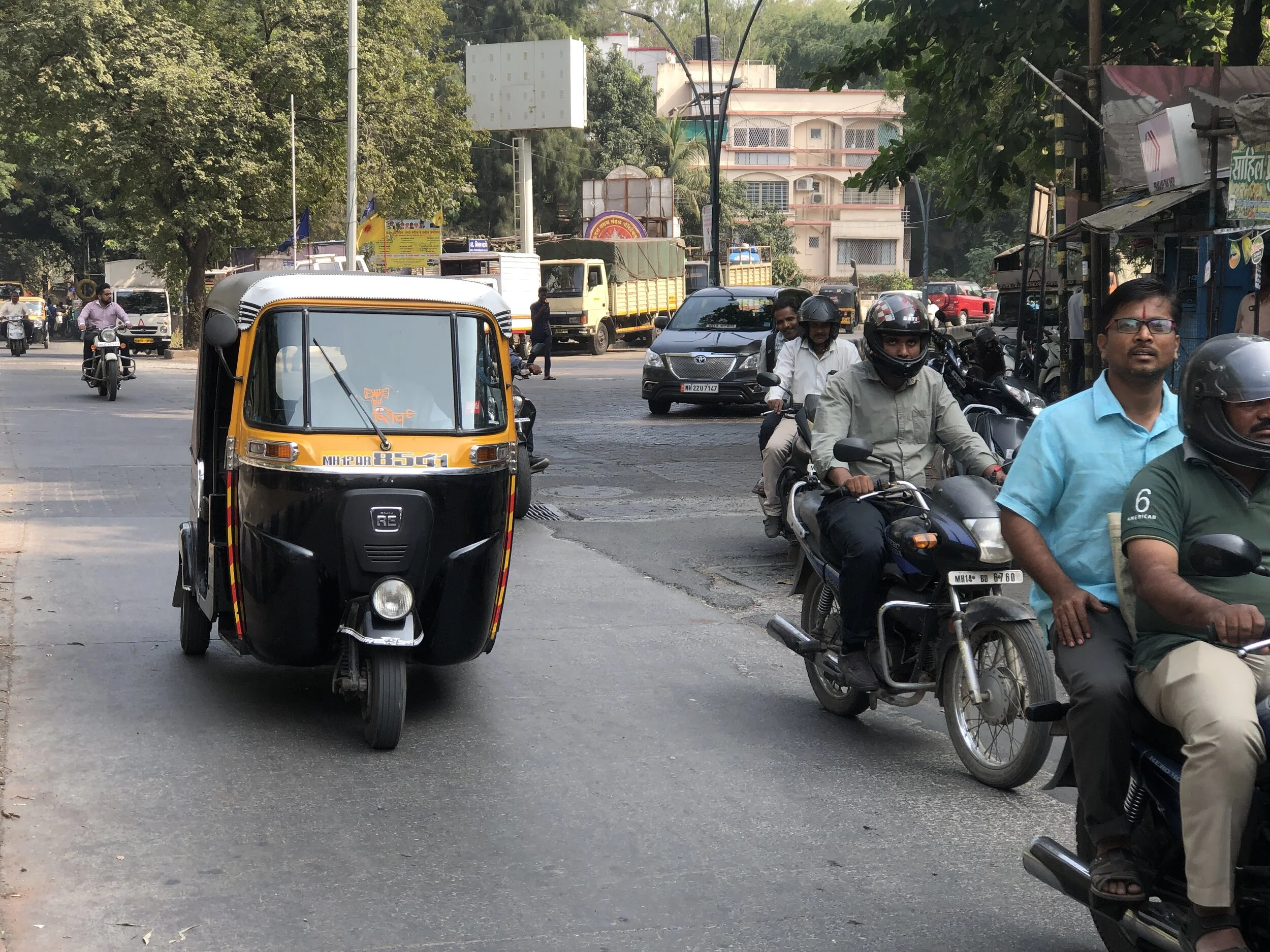
I think looking at the roads and how we drive and how they drive is a beautiful visual of what I am talking about.

Day #26 - Sitting for Prayers
What I am sharing below is a paraphrase from what I heard in class with of course my own slant.
How often do you sit tall and straight like a statue for the invocation?
What I am sharing below is a paraphrase from what I heard in class with of course my own slant.
How often do you sit tall and straight like a statue for the invocation?
How often do you sit for the invocation like you are doing Swastikasana for Instagram?
Sittig for prayers is different from sitting for an asana, or a meeting or the camera.
Furthermore in what condition do you arrive on the mat to start your prayers?
Have you rushed from work or home or dropping off kids?
The way you enter a shrine is very different from how you enter a sports stadium.
The place from where and how we begin will imprint on our practice.
Yes, we want to sit with the spine straight, not to impress the teacher.
We can use the sitting at the start of class to look within, get connected to our breath, allow the brain cells to submerge into the heart and we can get connected with the heart so the prayers come from there.
When I heard this being taught in classes here, I realised how robotic and mechanical my sitting for the invocation had become.
I loved this sweet reminder of the impact of small things.
Because everything here is imbued in Hinduism, I feel there is more opportunity to explain the prayers and they are to be done than in the west.
However, hearing these words have inspired me to find a way to express the importance of this ritual at the start of class, no matter the ethnic makeup.

Day #25 - Practice Buddies
In the practice sessions quite often people buddy up and practice together.
It is a great opportunity to tackle some of those more challenging asana, especially if your practice buddy is more experienced than you.
In the practice sessions quite often people buddy up and practice together.
It is a great opportunity to tackle some of those more challenging asana, especially if your practice buddy is more experienced than you.
Today Carole (my teacher) and I decided to practice together and we were going for arm balances because all week in class we had done so many backbends.
We decided to have 30 minutes doing our own thing and then we would come together for the arm balances. Lots of inner groins depending, sitting closed twists and forward bends
Then Lois Steinberg and Carole got chatting about the dates she was visiting our school (a practice often gets interrupted with teachers talking about logistics of visits or assessment) anyway Lois decided to join our arm balances gang.
You might not know, but in the hall along the walls are all the plates from LOY.
So our arm balance practice was pretty much just moving through all the arm balances plate by plate.
Many of which I have not done before or perhaps only once.
It was great because I could watch these very experienced teachers do it, try it myself and then they would give me corrections or points to make it more possible for me to do.
Then sometimes we would branch off on our own and keep working on a balance and then come back together and move on.
That is mentoring at it’s best. That is what we see everyday in the practice hall. People helping each other.
For example, I was practicing Eka Pada Sirsasana (not the one on your head, but where you take your leg behind your head) and I was doing it using the wall. I was practicing near Abhijata and she came up and kindly said, you are too close to the wall and went back to her practice.
They don’t tell you how to do, they just give you clues and the opportunity to figure it out yourself.
People are open and generous with their knowledge and time.
It is an incredible way for teachers to learn and I am all for creating an environment that supports more of this kind of learning and sharing.
Some of you are already familiar with my Peer Practice Program which is for trainees and teachers to come together and practice, learn, teach and share together online. Find out more HERE. Enrolments currently open to start live sessions in Jan 2020.
This is such an organic and natural way to learn, by watching and experiencing as a child would from their parents.
Here are a few of the poses we practiced today.
And can I preface this list with… we just did them, made the shape, attempted a second time with a bit more clarity and a third time and a fourth and they were by no means well done, they were simply an attempt.
Astavakrasana
Bakasana
Parsva Baksasna
Eka Pada Koundinyasana I
Eka-Pada-Bakasana–
tittibasana
dwi hasta bhujasana
Eka hasta Bhujasana
Sirsasana II going into some of the above asana too
There were probably others, it’s not really important, I just want to share with you that all these asanas should be attempted.

Day #24 - Prashantisms
I was in class with Sunita (Iyengar’s daughter) the other day and she said something like your brain is conditioned’ which means we see or experience things a certain way.
I was in class with Sunita (Iyengar’s daughter) the other day and she said something like your brain is conditioned’ which was said in the context of us not grasping a point she was making
So this led me to think that if we could un-condition the mind we would not be limited in our experiences and views.
But how do we remove conditions, we are presented with conditions every day.
With conditions, it means there are parameters by which we are receiving, doing, attending to something.
Whether it be a physical condition, age condition, mental condition, every day we are practicing with conditions.
My question to you is, are you…
Practicing with a condition and altering the practice to the condition
Practicing with a condition and observing how the practice is altered due to the condition
I’d love to know in the comments what is your mode of operands.
Then today Prashant was talking about how our knowledge is partial. He was holding a watch and said you can see the front, but not the back. He called it dimensional knowledge.
That is the context for my post, the words from Sunita and Prashant.
It got me thinking about how limited I am by what I think I know and I will share an example with you to make this all a little more practical.
I realised that when I look at Light On Yoga (LOY) I am usually checking, verifying or confirming something I know, rather than looking in LOY for new information.
I am opening the book but my mind already knows. Do you see how limiting this is?
“Search” was the word Sunit used when we open LOY.
Whether we are opening a book, having a conversation, doing an activity, if we always come to it conditioned we are missing a huge opportunity for learning and acquiring knowledge.
Are you following me?
I’m going to take one more leap…
Prashant also talked about knowledge being a means for quietening the mind.
When we don’t know something there is more turbulence in the mind.
For example, the plane is delayed and you don’t know when it is going to board the passenger, then your mind is in turbulence, if you can get some knowledge about how long it will be before you board your mind will be more quiet.
Which explains why we love to say “I know”. Or in conversations, we want to demonstrate that we know because if things are as we know then the mind is settled. SO we all want to know and say I know.
Do you see the predicament we are in?
Knowledge is a means to yogaś-citta-vr̥tti-nirodhaḥ yet we have to abandon what we know to be able to receive the knowledge.
OMG, I think Prashant just channeled through me.
Thank you for your patience.

Day #23 - Lost in Translation
When I first started Iyengar yoga the beginner’s class was 1.5hrs.
It was slow and methodical. It sometimes felt like we spent more time getting props and watching the teacher demonstrate than actually doing active yoga.
When I first started Iyengar yoga the beginner’s class was 1.5hrs.
It was slow and methodical. It sometimes felt like we spent more time getting props and watching the teacher demonstrate than actually doing active yoga.
There was attention to detail to the detriment of the class.
There was a sense that the teacher was focused on perfection and alignment and detail were more important than moving the body.
This is my memory of beginner classes when I first started Iyengar yoga.
10 years later when I started to teach, not much had changed.
And then just 3 years later there was a big shift.
The message came from Pune to the west that the classes need to be more dynamic, that we need to get beginners to just move and feel their bodies, stop using so many props and stop teaching so much intricate detail.
But I don’t know if all the countries got this message?
I don’t know how it is that if they were always teaching beginner classes in Pune, fast and dynamic then how that did not make it home to the western countries and we were doing it so differently?
Maybe they were not always teaching dynamically like this, as there are many things that BKS Iyengar did on his journey and changed along the way as he learned.
He too was mortal and it was not that he would master something the first time, we sometimes get that impression because of his book Light On Yoga, but we have to remember that it was a journey and we do not know what he did to get to where he got and that many things he must have adapted along the way.
Was this was just another adaptation?
The studio where I teach made the big shift, all beginner classes went to 1hr long and we (the teachers) had to change our teaching style.
We had to move and get the class moving. We stopped calling for props and demand more of the students to just do and not worry about how well they are doing, to shift the focus from perfecting an asana to just making a shape.
I assumed this happened all over the world, but I learned from my friend today who watched the beginner’s class with me that this is not how they teach beginners where she is from, they are still conducting beginners classes like we were 15 years ago.
Thanks you for your patience, I am now ready to bring my points together.
So much of what we pick up here in India and what actually makes it home sound is questionable.
So many things we gather here are lost, confused, misunderstood, understood but changed, accommodated to suit us, our culture etc.
The pure fact you are reading this in English, but what I heard/saw was in Indian English and Sanskrit, of course, something will be lost in translation.
So where is this going?
My point is, India is the best place to experience that nothing is fixed and nothing is permanent and every day in India you experience this fluidity.
It feels that they are having a joke on us, telling us one thing and the next class, something else.
Things are often being turned on their heads… Not to confuse but to un-condition us.
Being here in class is less about learning the asana and how to do a pose and so much more about challenging our perception.
Flipping things so that we might learn to be open, to be receptive.
Teaching us not to be attached… to expect nothing and be ready for anything.
I’d love to know in the comments what beginner classes are like in your country.

Day #22 - Mentorship
When you enroll at RIMYI for the month you can pay to just do classes or pay a bit extra to observe classes as well.
Of course, I am here to observe as much as do!
I observed a class today which Abhijata was due to teach and an unexpected thing unfolded before my eyes.
When you enroll at RIMYI for the month you can pay to just do classes or pay a bit extra to observe classes as well.
Of course, I am here to observe as much as do!
I observed a class today which Abhijata was due to teach and an unexpected thing unfolded before my eyes.
Just before the class started I observed Abi talking to two Indian trainees/teachers.
Next minute one of them was on stage leading the prayers.
Then Abi said something which commanded all the student’s attention.
The next minute the other teacher was on stage starting the students in the first pose and she proceeded to teach the students for the next hour, but the whole time with Abi very near to her and guiding her.
What I observed was a beautiful symbiosis between the two.
Abi had a head cold (I guess it’s going around) so to conserve her energy she taught the class through another teacher.
Having said that I imagine this is how much of the mentoring/teacher training is conducted here at RIMYI.
Sometimes Abi would give the teacher just one or two poses to teach and let her teach them, other times she would give her every pose, almost every word.
And not just asana and actions, there was philosophy woven in as well.
I thought how daunting for the teacher to have to teach in front of Abi and be scrutinised, but she took it in her stride and was a conduit for Abi while also being a teacher in her own right, sharing her own jokes, insights, etc.
I have never seen this done in any teacher training in the west, but I have heard it is done.
I’m curious teachers… what do you think about this style of mentorship?
Do you see this at the school you attend?
As many of the teachers know there are big changes in the wings for the current teacher training/mentor model, which will be a big shift from what we know and have been doing for decades.

Day #21 - Out of Balance
I got sick today!
No not Delhi Belli thank god, I have come down with a head cold.
I never get sick. Honestly, this is the first time I have been sick in 2019.
I got sick today!
No not Delhi Belli thank god, I have come down with a head cold.
I never get sick. Honestly, this is the first time I have been sick in 2019.
I’m not telling you this to boast, but because what I have realised is I rarely do restorative yoga because I associate restorative with being unwell or not having energy.
My teacher (who I am here in Pune with) said to me “you have a license to rest”.
Why does it take me being sick to do restorative asana?
Why do I have to be sick to have license to rest?
I am such a doer and to be honest, lying over a bolster feels like a waste of time.
Prashant raved last week about bringing more awareness to our practice, not just doing.
He spoke about ‘watchasana’ (he loves to make up words) watching and observing ourselves in the asana, not just doing.
And it is in the supine asana that we can better watch the breath and the mind and tune into the subtleties of the asana.
So today I was forced to do restorative practice only.
I would benefit from doing more restorative. Yoga is after all to create balance, in which case I need to do less and observe more.
My practice today was
Supta Swastikasana 5 minutes each leg
Supta Buddhakonasana 5 minutes
Supta Virasana 5 minutes
Supported Matsyanasasna
Padmasana
Dwi Pada Viparita Dandasana over the back bender
Setu Bandha over a simhasana box
Adho Mukha Swastikasana over simhasana box

Day #20 - Endless Possibilities
There are endless ways to practice one pose and I mean endless.
I have talked about the practice hall being a pool of inspiration but it just reached a new level.
There are endless ways to practice one pose and I mean endless.
I have talked about the practice hall being a pool of inspiration but it just reached a new level.
I have never seen Padmasana done so many different ways.
Yes, it is great to get ideas from seeing other people doing, but also I realised we don’t need to wait to be shown.
We just need to explore in our practice, we need to be adventurous and courageous and curious.
We need to be playful and light and experimental.
I used to think you had to do a pose the classical way and get all the actions right and doing a good pose, but the practice all is the opposite of this.
People are trying stuff out and working together, helping and supporting each other.
And people are going solo too, making their own discoveries.
I have practiced padmasana every day since being here and I think I have done it differently each day and wow, not only the progress but the learning and freedom that is coming is amazing.
looking at all the variations, doesn’t it give you some idea of ways to play with padmasana?


Day #19 Inspired by Geeta
I mentioned in Day #16 post that there were many stories shared about Geeta.
I was reflecting on one story in particular in which Geeta had been watching a student struggling with her practice in the practice hall.
I mentioned in Day #16 post that there were many stories shared about Geeta.
I was reflecting on one story in particular in which Geeta had been watching a student struggling with her practice in the practice hall.
Geeta called her over and amongst many things, one thing she said was along the lines of “you are young, you must attempt the challenging poses, if you don’t do them before you are 50 then there is no chance” and then she went on to say something like “If you don’t know what to practice, copy what the seniors are practicing and if you still don’t know, come and ask me”
Pretty cool eh!
So that is what I did in my practice today.
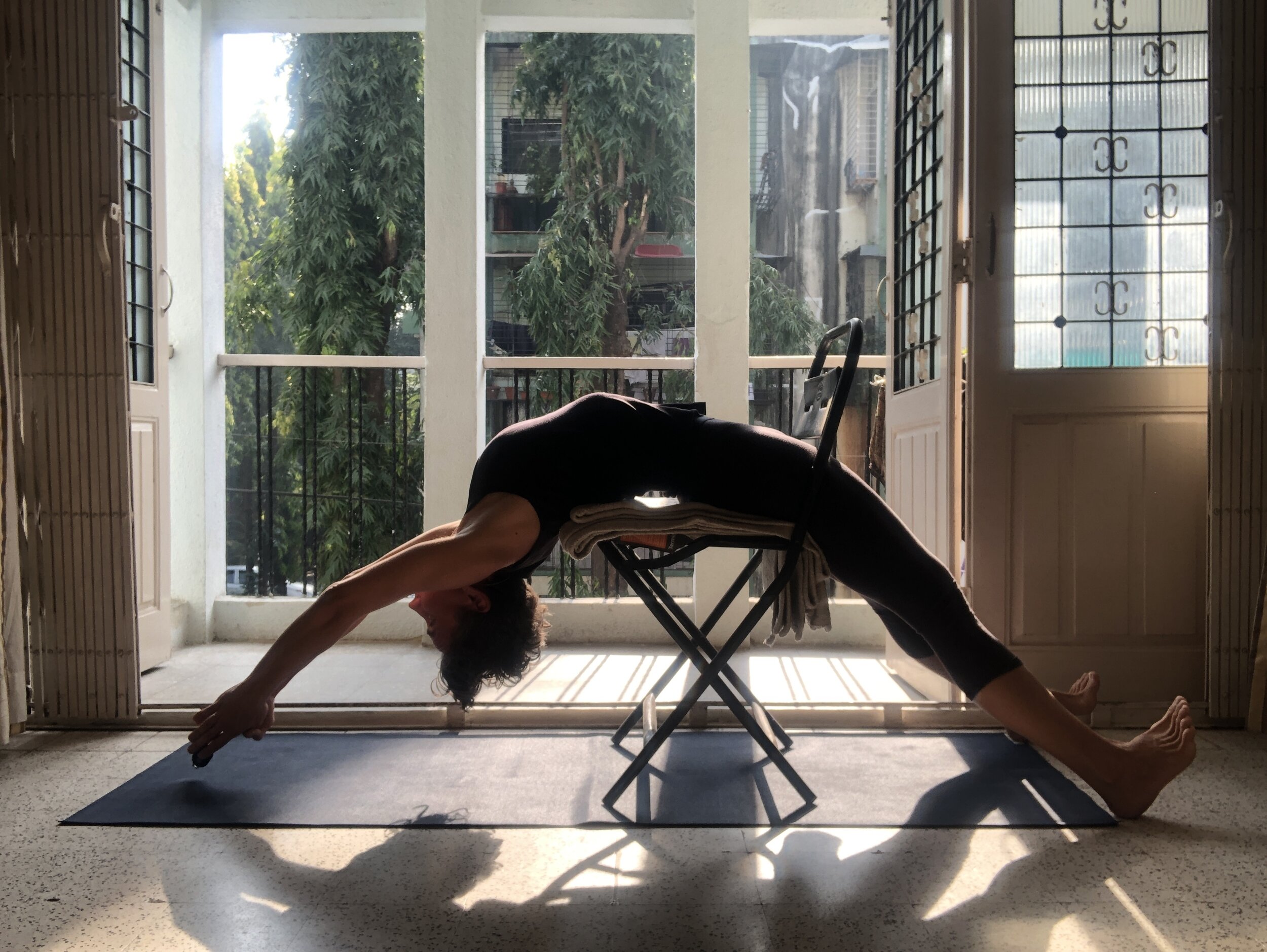
I attempted pose I am afraid of, poses I have never done before and don’t know how to do.
I copied what I had seen done or saw today in the practice hall.
I did headstand drop backs, handstand drop backs, I did poses I don’t even know the name of, but there were students in the hall doing them, there were pictures of BKS Iyengar doing them, so I just copied best I could.
I did lots of padmasana variations and I did padmasana in Sarvangasana trying my best to not use my hands to get the feet entwined.
I attempted and not just once, many times.
I discovered there is nothing to be afraid of, it’s just noise in my head.
I discovered I could do much more than I thought. And when you have done something once even if poorly, you at least know the steps to take to get there again.
So please in your practice ‘just attempt’ some poses that you are not familiar with and bliss will come.
I insist that you comment below and tell me what asana you will attempt in your practice that you don’t ever do or that you need ideas for how to approach, I’d love to help you.
Day #18 - I've a Confession to Make
Actually I have a couple of confessions.
Confession #1, today I skipped class!
Actually I have a couple of confessions.
Confession #1, today I skipped class!
While I have been sharing with you the golden nuggets from Prashant’s class, they can be the most agonizing 2-3hrs you have even known. That’s confession #2.
The catch is you have to sit through (yes sit) the 3hrs out to get the small nuggets of gold.
Prashant’s classes are more often than not, sitting and listening to his philosophy which is interspersed with a few asana.
My back has been cranky ever since I arrived, so sitting static for 3hr has been agony and I just couldn’t take another day of it, so I skipped class and practiced at home.
This practice was very familiar to me in the sense that, I got on the mat and struggled, thinking what to do, summing up the gusto to get into it, to push myself, to move dynamically, because this is what my body needs most right now, but it was a struggle to start.
Then at some point, I got into a groove and could feel the energy rising and then I pushed myself, I did a classical version of asana I really struggle to do, I pushed beyond my comfort zone, I breathed out, I initiated more.
What can I say, by the end, I did not want to stop, but for the sun in my face.
We can go to many classes, we gather so much knowledge, but what is it good for if we don’t take it onto the mat with us and practice what we have gathered in our database.
Thank you, Prashant for empowering me and apologies for not coming to class today, but the inner teacher could not be silenced today.
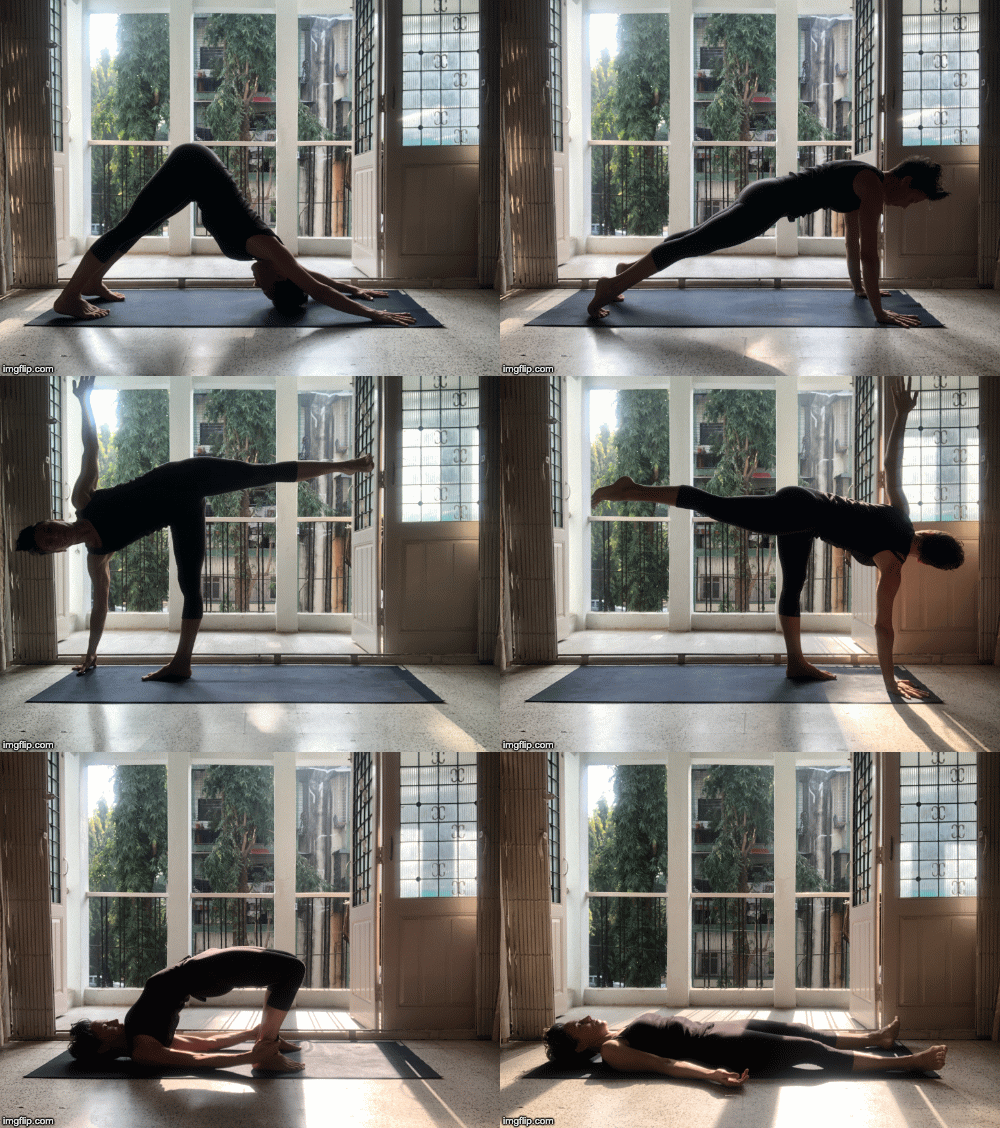
Here is my practice.

Day #17 - Full Wash Cycle
Give me a class any day, yell at me, tell me what to do, tell me to do things I never do or don’t want to do.
I’ll do them! I am at your mercy. I trust you.
Give me a class any day, yell at me, tell me what to do, tell me to do things I never do or don’t want to do.
I’ll do them! I am at your mercy. I trust you.
This is how I felt today when Abhijata gave us an asana class.
I felt like the rat willing to serve Ganesh in any way he commanded.
It was the full wash cycle. Not the half load, not the quick wash, the full wash cycle.
As these posts I’ve written about the inner teacher, the importance of practice, blah blah blah, I just want to contradict myself and say “give me a full wash cycle any day”
The power of this young women’s voice, how she commanded us, how she laughed and joked, how she gave alternatives, how she taught was fantastic.
I had one of those experiences where you can do every pose and it feels easy and you can all of a sudden do a pose you couldn’t do before and you that like as long as they keep commanding you can just keep doing.
So… we need a balance, we need these full wash cycle classes that wash you, rinse you and spin you as well as a home practice which is more often than not a half cycle, or quick cycle.
This is why I always say that classes are essential to a home practice and complementary to a home practice and you can’t have one without the other.
The challenge is bringing the full wash cycle home.
One way is to include more challenging poses in your practice. You might not be practicing like someone is cracking the whip, but the more challenging poses will bring intensity and depth to your practice.
They are often saying here in Pune not to limit your practice to your assessment syllabus, but to practice poses from the syllabus above you.

Day #16 - Geeta’s Teaching Lives On
This evening event was to remember Geeta and her contribution to the Iyengar community.
I only met Geeta once, 2 years ago when I first came to Pune, she conducted the medical classes and taught a few classes at the Russian intensive which general students were invited to join as well.
This evening event was to remember Geeta and her contribution to the Iyengar community.
I only met Geeta once, 2 years ago when I first came to Pune, she conducted the medical classes and taught a few classes at the Russian intensive which general students were invited to join as well.
So I got a very small taste of her fire, her passion and her devotion to the yogic path, but there is I learnt tonight there is so much more to Geeta S Iyengar than the common way many of us know her.
This evening people from around the world, international students, family members, Indian students and teachers spoke about Geeta and their interactions with her and now I feel I know her more.
One thing they all spoke about was her fire and how fierce she was but also her heart and how considerate and kind she was and how much she did to help people.
I practiced at home for 3hrs this morning and there was a fire in my practice and I pushed myself like a teacher pushes you in class. There was an energy in my practice that drove me, but it was not me.. It was like Geeta was there with me, asking me ‘what are you doing?’, ‘why are you doing it like that?’, ‘stay, stay, more, more’.
While she has left this world may she forever be present in our practice and teaching.
The evening ending with a huge banquet feast put on by the Iyengar’s.


Day #15 - Guruji's 101 Birth Date Celebration
No words are needed, this demonstration says it all.
No words are needed, this demonstration says it all.

Day #14 - Core of Iyengar Yoga
Abhijata gave a talk on the Core of Iyengar yoga.
The idea to talk on this topic came to her because she often gets emails from students and teachers around the world who are confused about what classifies Iyengar yoga teaching.
Abhijata gave a talk on the Core of Iyengar yoga.
The idea to talk on this topic came to her because she often gets emails from students and teachers around the world who are confused about what classifies Iyengar yoga teaching.
An email she recently received was from a student who had observed that senior and notable ‘Iyengar’ teachers are teaching at ‘Iyengar’ schools around the world but what they are teaching is not necessarily pure ‘Iyengar’ yoga. So there was a question of mixing styles and wanting guidelines.
Abhijata thought if she could define the ‘Core of Iyengar yoga’ she would be able to respond adequately to this email.
Her talk (in my opinion) was impeccable. It was well crafted, took us on a journey that considered so many conditions that need to be addressed to answer the question and then concluded with the core of what Iyengar yoga is.
I will not try and impart the journey she took us on in her talk, I would not do it justice. I hope they share the recording of it with the public.
What I am keen to share with you is what really challenged and resonated with me.
In the context of the future of Iyengar yoga now that Guruji has left us and also Geeta, a big question hangs in the air of how and what is Iyengar yoga without these seminal figures?
Abhijata said we need to be as honest as BKS Iyengar was.
Since starting Yogabranches I have been questioning if this online offering is or is not disseminating Iyengar yoga around the world in a honest way.
I have doubted and questioned if starting Yogabranches is right, correct, respectful.
It has been a big worry for me. I have been in fear of retribution.
I have often sought external approval.
But now after listening to Abhijata, I know that I will never get external approval. I will never know if what I am doing is wrong or disrespectful…
I am not going to find the answer to these worries outside. I will only find the answer to this from within.
Abhijata said something like… to potentialise the Iyengar system without disrupting the foundations we need to be honest.
We need to question, am I loyal to the system? am I bending the system to my benefit?
Because we often choose what is convenient for us and we look for justification for that in what someone said or what we think they said.
We can trick and lie to ourselves.
We have to ask ourselves ‘what am I doing’, ‘why am I doing’ and ask ourselves the same question three times to strip back and drill down and get to the truth.
The first time we ask ourselves we will give a superficial answer, the second time we will come with something more, but the third time we will have nothing to hind behind and come to the truth.
We need to question, observe, be aware and comment on ourselves. This kind of honesty take courage.
I understood that if we can objectify the mind we are on the right path to
remove impurities
be discriminative
carry the flame of wisdom
As BKS Iyengar did.
So, the core of Iyengar yoga is Yoga.

Day #13 - Teach with Conviction
There has been a great deal of talk about what makes a good teacher this week in the context of the seniors/assessors meeting.
It has been made loud and clear that just because you can do good postures it does not mean you are a good teacher.
There has been a great deal of talk about what makes a good teacher this week in the context of the seniors/assessors meeting.
It has been made loud and clear that just because you can do good postures it does not mean you are a good teacher.
Rather, be a good student and you will make a good teacher.
Prashant spoke about studentship and how this is lost when we become a teacher.
When we get certified we say ‘now I am a teacher’ and we can abandon our studentship.
We need to teach with conviction, it is a quality of any teacher, but not at the expense of our studentship.
Prashant gave a beautiful analogy that our studentship needs to be taken care of like a baby. He said “protect your studentship which is forever an infant”
I am jealous of the students who are here for the month that are not teachers. They can just do the yoga and enjoy it without their teacher’s hat getting in the way, without spending hours writing notes adding to the database of information that a teacher develops.
I often say I am a student first and foremost and this is not rhetoric, this is my experience.
I have been taught this by my senior teacher. When I was in class in one of the first years of teacher training she pulled me up and said, be a good student, you are a role model for the other students.
She said this because she saw me in her class with my teacher’s brain on, she was teaching something and I was doing something she had taught yesterday.
It’s like we have to empty ourselves after every class and be ready to move on to the next thing.
I am not suggesting we dispose of what we have learned, but not grip and attach ourselves to it like it is gospel.
And of course, this habit needs to start in our own practice. To each day start fresh and explore and enquire in our practice and never say ‘I know’.
I feel inspired to come to everything in life with this attitude.
Imagine every time my children want to tell me something (and often we know along the lines of what they are going to say) imagine being completely open to what they are going to say, no presumption, no assumed knowledge, and as a result, no premeditated answers or judgments and as a result, we wouldn’t have the same reactions and the whole interaction would be full of potential.
If we can practice this on the mat then let’s hope it will come to us off the mat too.
Day #12 - The Teacher Within
I was pleasantly shocked to learn that there is a teacher within me that is adequate for this journey.
In today’s class, Prashant suggested we are “teacher bound in class” meaning we have lost trust in ourselves and lost touch with the teacher within.
I was pleasantly surprised to learn that there is a teacher within me that is adequate for this journey.
In today’s class, Prashant suggested we are “teacher bound in class” meaning we have lost trust in ourselves and lost touch with the teacher within.
Our attention is so focused on the teacher, showing us something or teaching us something that we are missing the opportunity to learn something from ourselves.
He suggested that if we give our breath the same focus and attention we give the teacher we could learn a great deal about an asana just through the breath.
We have a teacher within us that is not being acknowledged and Prashant says his role is not to teach us but to be a conduit that connects us with the teacher within us.
I thought this was beautiful. He often speaks about yoga education to empower the student and today I truely felt empowered by his words.
Have you lost touch with the teacher within you? Are you seeking a ‘good’ teacher outside?
This is a bit far fetched, but the issue of climate change is in my FB news feed, on the TV and Prashant is talking about it and it got me thinking that if we all stopped flying across the world and driving across the city looking for a ‘good’ teacher to teach us a yoga class and just practiced at home with the teacher within, the Iyengar yoga community of the world alone might have a small impact on climate change.

Day #11 - Sustaining & Surrendering
In today’s class, Prashant had two yoga practitioners on the stage to demonstrate a point and that is what I want to share with you today.
He had one practitioner over a back bender bench in a supported Dwi Pada Viparita Dandasana and the other practitioner in an active Dwi Pada Viparita Dandasana.
In today’s class, Prashant had two yoga practitioners on the stage to demonstrate a point and that is what I want to share with you today.
He had one practitioner over a back bender bench in a supported Dwi Pada Viparita Dandasana and the other practitioner in an active Dwi Pada Viparita Dandasana.


IMAGE: LIGHT ON YOGA
What he pointed out in the supported pose was how the practitioner was not laboring. How the laboring was outsourced and because of this he could surrender in the posture and as a result, understand what the breath was doing and comprehend the intricacies of the asana.
He pointed out how the practitioner in the active pose was sustaining the posture with his will power. How he was sustaining the post with his arms and legs and back. How he was laboring in the posture and how this is not the time to understand the breath in the asana because he is using all his faculty to just sustain.
As the class was about the breath and how the breath is different in each asana, he used this very visual demonstrate to educate us about the optimum time for this kind of learning about the breath and went on to say that Guruji used the props to practice in a way that the subtleties of the posture could be grasped so that when he was practicing the pose actively he could then incorporate these intricacies into the classical posture.
He also spoke about not just doing supported postures because you are tired but doing the supported postures with the intention to educate yourself about the subtleties of the posture.