

Practice Point #98 - Dizzy From Yoga
Down dog and sometimes forward fold or other inverted poses make the blood rush to my head and I feel dizzy. Will it get better or should I avoid these poses?
I received a question from Cher from the USA. Their question is...
Down dog and sometimes forward fold or other inverted poses make the blood rush to my head and I feel dizzy. Will it get better or should I avoid these poses?
In short, I would avoid these poses if you have a condition like glaucoma, brain tumor, etc. that do not advise pressure in the head face region.
If you do not suffer from any condition like this, I am guessing the pressure will release with practice.
I notice that if I have not practiced headstand or shoulder stand for a long period and then do, the pressure in my head is greater than when I practiced them regularly.
I encourage you to keep practicing them but with a few modifications.
When you practice these postures, don’t come straight up to standing afterward, rather bend your knees and go to kneeling, bring your head up last. Then graduate to standing and bringing your head up last and slowly.
Hold these postures for a short duration to start, like 3 breaths, gradually increasing the hold as the dizziness and pressure reduces.
I hope you find this helpful.


Practice Point #97 - A Balanced Practice
With the lockdown it has been hard to practice a sequence . Is it ok to do only sirsasana & it’s variations as a practice and a short setubanda to finish Early in the morning?
I received a question from Peter Chatz from Australia. Their question is...
With the lockdown, it has been hard to practice a sequence. Is it ok to do only sirsasana & its variations as a practice and a short setubanda to finish Early in the morning?
I have to put this question back to you.
How do you feel when you do only Sisrasana (headstand) followed by a brief setu bandha?
How you feel after this practice will be an indication if it is suitable for you or not. Keep in mind that practice has an accumulative effect.
I have a few suggestions to help you make it a little more balanced. While a headstand is great for building concentration and focus and also soothing an active mind, it is a stimulating pose and if every day you are doing a stimulating pose and only a brief cooling pose, over time I believe you might feel out of balance.
I would encourage you to do a shoulder stand or setubanda for at least as long as you do the sirsasana (headstand) to get more balance in your practice.
Of course, if you have more time, I would include some arm postures and dog poses before the headstand or a few standing poses, and after the setubanda try and include a few sitting postures to get a more all-rounded practice.


Practice Point #96 - Neck, Shoulder, Back pain
I have a lot of neck/shoulder/back pain. What poses do you suggest for relief?
I received a question from Sandra Spagnuolo from the USA. Their question is...
I have a lot of neck/shoulder/back pain. What poses do you suggest for relief?
It does depend on the cause of the pain.
Is the pain due to sitting for long period at a computer or from an injury?
Depending on your answer my response will be different.
I am going to address the question from prolonging sitting and computer use as this is very common and will help all the readers.
I would recommend daily doing arm positions like gomukhasana, garudasana, namaskarasana, bahhdha hastasana, parva baddhanguliyasana to help relieve tension in the neck and shoulders.
Daily I would also make sure you take breaks from your computer every 25 minutes to stretch your back with ardha uttanasa and a sitting twist to release the upper back.
Supta padagustasana will help release the lower back.
Here are some pictures to guide you on these postures.


Practice Point #95 - Meniscus Tear
You mentioned that you had a torn meniscus… did you have it repaired? If not, how did you get around the pain? I have a torn meniscus so I’m hoping not to have surgery again.
I received a question from Arlene Nesbitt from Canada. Their question is...
You mentioned that you had a torn meniscus… did you have it repaired? If not, how did you get around the pain? I have a torn meniscus so I’m hoping not to have surgery again. Thank you
Yes I torn my meniscus twice actually and both times had is surgically repaired.
It is a very uncomfortable pain from memory and while the pain can vary depending in the degree of the tear in my case and for my profession I decided it was necessary to have the surgery.
However after the first surgery, I never felt the recovery was 100% so the second time I took a much more proactive approach to my rehabilitation and to this day have a fully functioning knee and returned to be able to practice padmasana and virasana.
I do not have an answer for how to get around the pain. The pain is there is send an important message to my brain to be careful and that more harm is about to occur if you proceed into the pain.
I am not suggesting that surgery is the only answer, rather from my experience I do not have any solutions to practice without the pain, except to back off. You will need to adjust your expectations of your ability to do certain poses and letting go of this attachment can often be more challenging than the injury itself.
Good luck.


Practice Point #94 - Hips and lunges
From plank (on Arm) I struggle to bring my leg up between the arms(palms). How can I achieve that?
I received a question from Sandhya from Australia. Their question is...
Hi there .. From plank (on Arm) I struggle to bring my leg up between the arms(palms) . How can I achieve that ?
I am not sure I have understood your question but I have understand you are asking how to step up to a lunge from plank and this is difficult for you.
I would recommend putting blocks under your hands, when you increase the height of the hands you are creating more space for the hips and knees to maneuver. If blocks are not high enough you can also put your hands on the seat of a chair for more height.


Practice Point #93 - Times of Day to Practice
“I'm on medication for my heart, and getting up early is difficult for me. I don't sleep well. Is there a way to do my practice, not in the morning? I was doing the morning start for the 5-day kick start yoga but then I'm tired later. If my sleep was better I'd be more optimistic about an early morning start.”
I received a question from Jill Dobkin from India. Their question is...
I'm on medication for my heart, and getting up early is difficult for ne. I don't sleep well. Is there a way to do my practice not in the morning. I was doing the morning start for the 5 day kick start yoga but then I'm tired later. If my sleep was better I'd be more optimistic about an early morning start.
Thanks for your question and while it is quite specific I will answer it more generally so that others can also benefit from this question.
If you don't sleep well, I would focus on a practice before dinner that includes inversions and forward bends to help promote better sleep. Try this a few times a week for a couple of weeks.
While your sleep is not good, I would recommend that if you are attempting some kind of practice in the morning to just do supta baddhokonasa and Viparata dandasana over crossed bolsters or postures similar to theses as they will give you energy without using any to practice them.
Here is an example insomnia sequence to practice pre bed.


Practice Point #92 - Beginners
How much time should I practice for and what poses are the best to practice for beginners! How much should each pose be held for?
I received a question from Ruth Brown from the United Kingdom.
Their question is...
How much time should I practice for and what poses are the best to practice for beginners! How much should each pose be held for?
I recommend practicing daily but briefly.
Consistency and regularity is more important that duration when you are starting out.
I would recommend attempting to do 10 minutes daily. As for the best poses to practice for beginners, I would suggest standing poses like Trikonasana (triangle pose), Virabhadrasana 1 & 2 (warrior 1&2), Parsvakonasana (extended side angle), and arm positions seated in swstikasona or virasana. And of course dog pose and forward hero pose.
Hold each pose by counting your breath, how many breaths I can't tell you, but perhaps start with 3 breaths and you can increase from there over time as your strength and stamina improve.


Practice Point #91 - Menopause
Can you suggest any series or asanas for women undergoing menopause?
I received a question from Rashmi Jain from India. Their question is...
Can you suggest any series or asanas for women undergoing menopause?
Menopause has different effects on different women and different sequences will be more appropriate depending on your symptoms.
Here is a restful sequence as well as one for mood swings.
Restful Sequence
Supported Uttanasana
Supported Adho Mukha Svanasana
Gentle backbend with 2 folded blankets under the shoulder blades, rolled blanket under the neck, and bolster behind the knees
Supta Baddhakonasana
Viparita Karani
Mood Swings
Supported Adho Mukha Svanasana
Supported Uttanasana
Prasarita Padottanasana
Sirsasana
Viparita Dandasana
Support Sarvangasana
Supported Arhda halasana
Setu Bandha Sarvangasana
Viparita Karani, legs up the wall, legs upavista konasana up the wall, legs in baddhakonasana up the wall, legs cross on the bolster
Savasana
Kate
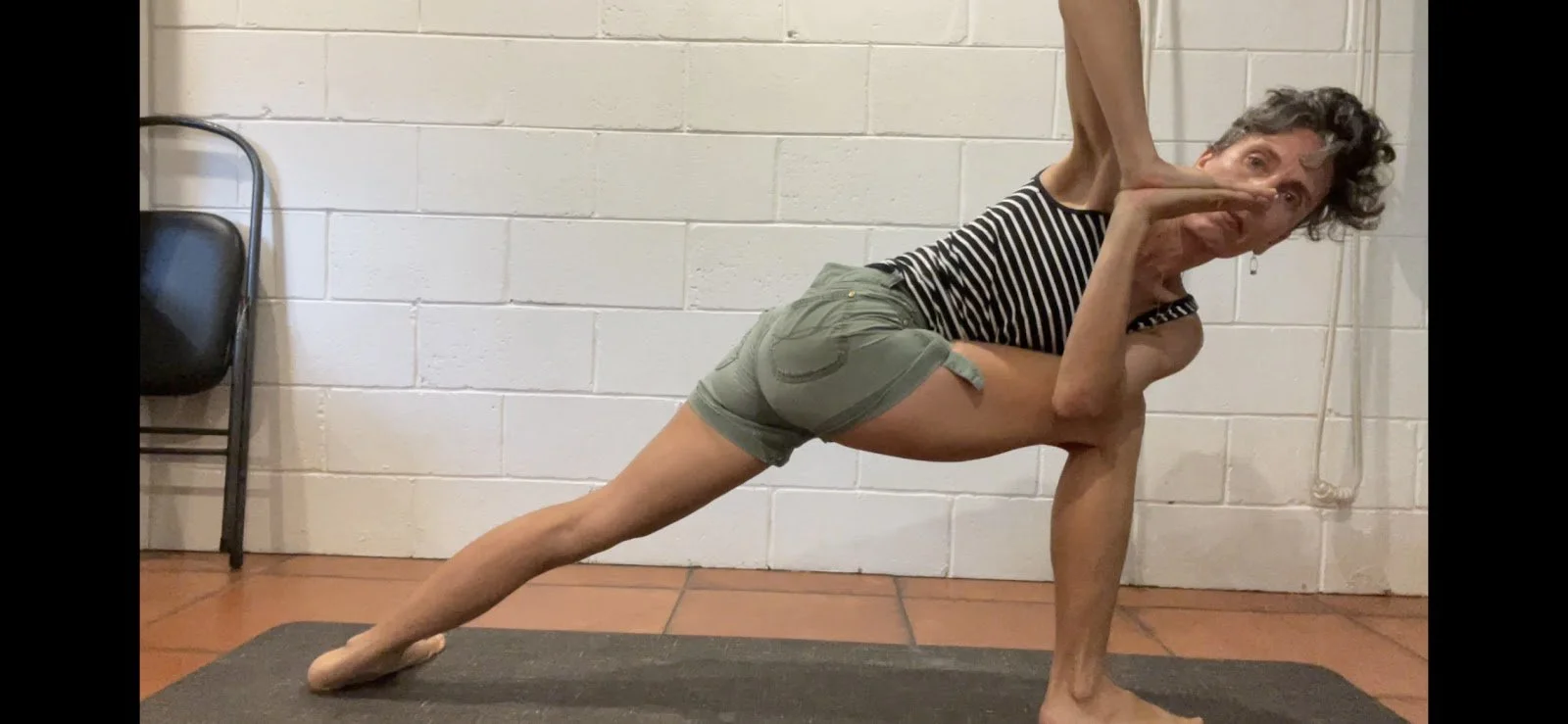
Practice Point #90 - Pravritta Parsvakonasana
“I am also wanting to know about Pravritta Parsvokanasana, in your pics you show heel up? I have always been instructed the outside of the back heel must be down, I know heel up helps to bring the back hip around and this does allow greater freedom, how do you suggest then to work toward heel down, it seems for me it has to be one or the other.”
I received a question from Shelly Mcbean from the Australia. Their question is...
Hi Kate I am also wanting to know about Pravritta Parsvokanasana, in your pics you show heel up? I have always been instructed the outside of the back heel must be down, I know heel up helps to bring the back hip around and this does allow greater freedom, how do you suggest then to work toward heel down, it seems for me it has to be one or the other.
Yes you are correct there is more freedom in the hips with the back heel up and this is why I often teach this version.
Having said that the classical pose does have the heel down and while more freedom is found in the hips with the heel up more length in the torso and it is a much greater twist with the heel down which can feel fantastic to taste.
If taking the heel to the floor is out of reach try using a brick on its wide edge at the wall and taking your heel to the brick so that you have something for the heel to work towards.
Once the heel is reaching the brick you can take a half brick and gradually work towards the floor in this manner.
Another thing to note when attempting to take the heel to the floor is the extension of the arm which is hooked over the knee.
You can take the hands to a prayer position instead of extending the hand to the floor, this will give you a little more freedom to take the heel down.
Sometimes we have to give somewhere to reach somewhere else, then the body begins to learn how to extend in a new area and eventually all areas.
Don't be fixed on the final posture with the hand and heel on the floor, be curious and explore. Ask yourself questions and the learning will be rich.

Practice Point #89 - Tight Hips and Thighs
“I have very stiff hip muscles, and in addition, my sides of the thighs which has Illio tibial band and other muscles are also very tight, which makes even attempt At Padmasan very painful. Please guide how can I get more mobility in those areas?”
I received a question from Paresh from India. Their question is...
Hi, I have very stiff hip muscles, and in addition my sides of the thighs which has Illio tibial band and other muscles are also very tight , which makes even attempt At Padmasan very painful. Please guide how can I get more mobility in those areas ?
You are not the only one.
One things I think is great for releasing the Illio Tibial Band is a foam roller. I find this gives instant release, but you do have to do it regularly otherwise this band will just tighten up again.
And you are right when the hips are tight it makes postures like Padmasana very challenging.
So I recommend working with the introductory postures that lead towards padamasana to help open the hips.
It requires regular disciplined practice of these postures for you to see a change in the openness of your hips.
Regularly practice baddhakonasana, janu sirsasana, upavista konasana.
Furthermore practicing these postures with the back on the floor, buttocks to the wall makes them feel quite different and gives a new freedom in the hips.
As per the image give it a try.


Practice Point #88 - Challenging Poses
How to practice ek pada sirsasana and kurmasana ?
I received a question from Mehul from India. Their question is...
How to practice ek pada sirsasana and kurmasana ?
Here is a sequence that will help you prepare for these postures.
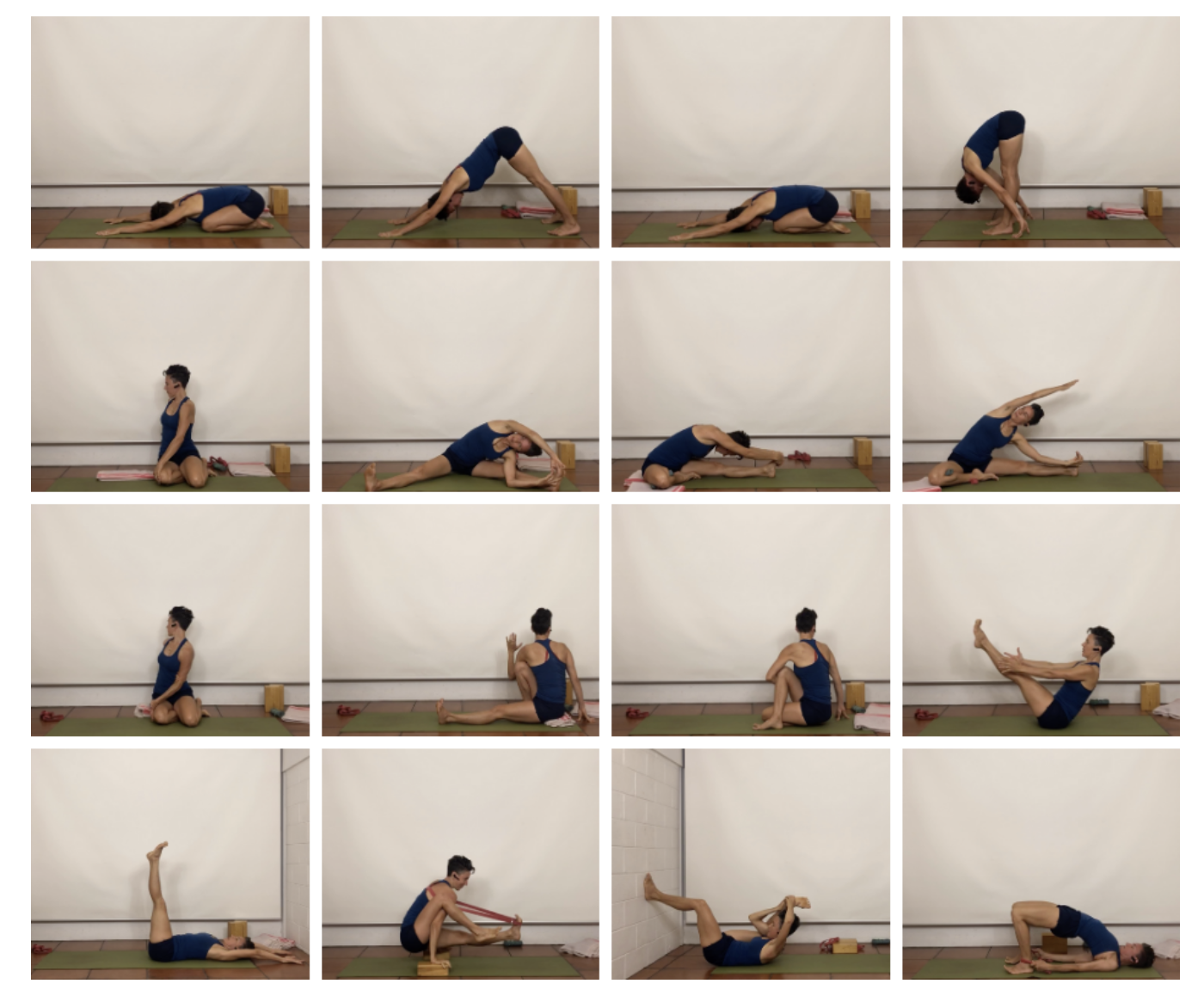
If you are a member of the Yogabranches Home Yoga Practice membership this video class is available in the portal and you can follow along with instructions.
As you can imagine it is a bit hard to tell you how to practice these postures in a email right.
So use this sequence as a starting point.
good luck
Kate

Practice Point #87 - Menopause
Do you have any advice on poses that are good to practice during menopause or poses that should be avoided?
I received a question from Trish. Their question is...
Do you have any advice re poses that are good to practice during menopause or poses that should be avoided?
In this time of life we want to use yoga to keep your endocrine system in balance, or bring it into balance if it is stressed.
The endocrine system is made up of all the body's different hormones, regulates all biological processes in the body.
So think pineal gland, adrenal glands, pituitary gland, thyroid glands.
So we want to practice a variety of yoga poses, more specifically forward bends, twists and backbends and inversions to pacify, then activate the glands.
I want to keep this simple and accessible to all.
So I am just going to give a couple of postures that you can trust will be beneficial at this stage of life.
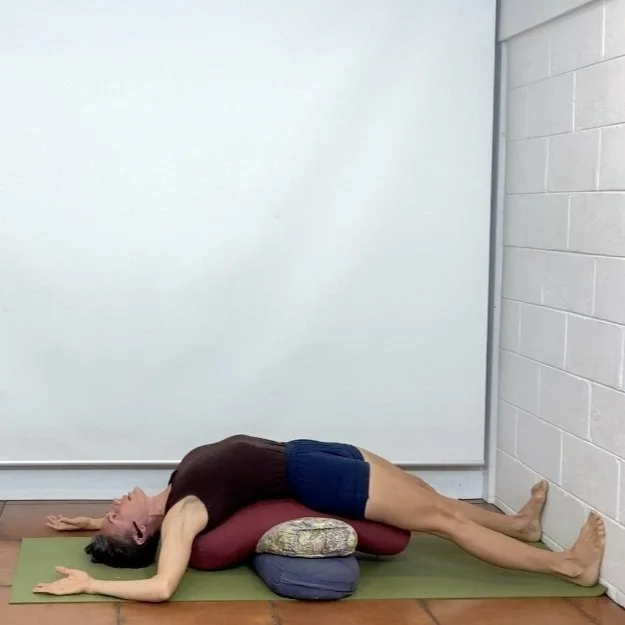
Let’s start with the Inversion category. Headstands are excellent for activating the pineal and pituitary glands, however they are heating and we all know hot flushes are a symptom of menopause so to avoid overheating the body you can take supported dwi pada viparita dandasana instead.


Practice Point #86 - Fanny Farting
How do I stop vaginal farting?
I received a question from Anonymous from the Australia. Their question is...
How do I stop vaginal farting?
As embarrassing as it is, I am so happy this question was asked.
How to stop the vaginal mouth from taking in air in inversions?
A few things about this if you are lucky enough to not have experienced it.
When women invert the vaginal mouth can take in air, then we you come down from the inversion the vagina makes a farting sound which is terribly embarrassing.
I know it has happened to me.
It only happened to me after I had children and it also happened more often after menstruation. So you might like to start to observe when this happens to you to give you some clues.
The reason for this unfortunate incident is that the vaginal mouth is higher than the anal mouth. What this happens is the abdomen gets pushed forward and the uterus is pumped up and down which causes the vaginal mouth to suck air in.

So when inverted there are a few things to keep in check with your alignment.
Firstly, do not tighten the vaginal mouth, this is not correct.
We can correct this vaginal breathing through the alignment of the spine.
So when you are next inverted check this
The abdomen is held back towards the spine not pumped up towards the legs. To do this lift the pubic bone vertically up toward the torso
This will naturally take the tail bone up which will take the anal mouth up and the vaginal mouth down which is the correct position to avoid the vagina taking air.
It takes practice, but you will find it will benefit your whole sirsasana and the same applies in sarvangasana.
Should you have an accident and suck air in, you can control the release of the air out so it is not so loud, or let it rip, your not the first:)
Kate

Practice Point #80 - Bakasana
I find Bakasana (Crow Pose) challenging. What suggestions do you have for hand and shoulder positioning? How bent should the elbows be? How can I achieve a feeling of 'lightness' in the pose?
I received a question from Miranda from the Canada. Their question is...
I find Bakasana (Crow Pose) challenging. What suggestions do you have for hand and shoulder positioning? How bent should the elbows be? How can I achieve a feeling of 'lightness' in the pose?
The amount of times people ask about Bakasana, I do wonder what the fascination is with this posture?:)
That aside, I'll break the bad news to your first. The arms are actually working towards being straight in bakasana. This is the final action when completing the pose to extend the arms in which case t he knees are not resting heavily down on the back of the arms rather they are gripped.
One way I found the feeling of lightness is to launch of bricks. With feet on bricks I am then working towards just lifting the feet off the bricks which is not as far as from the floor.
I notice that many students take their buttock high into the air and I believe this is an attempt to make the pose lighter, however this makes the pose less compact and I believe harder to balance. Try keeping your but as close to your heels as you launch off your bricks.
Let me know how you go.

Kate

Practice Point #31 - Hip Flexors
My front groin or hip flexors are too flexible because of anterior tilt. The front thighs go too forward in lateral standing postures, how to control?
I received a question from Chanda in India. Their question is...
My front groin or hip flexors are too flexible because of anterior tilt. The front thighs go too forward in lateral standing postures, how to control?
There are those with a more pronounced posterior tilt and those with a more pronounced anterior tilt.
If you are not sure which is which let me give a little explanation.
A posterior pelvic tilt (probably more common) is when the tailbone is tucking under towards the pubic bone and the pubic bone lifts up towards the belly button. Anterior tilt is the opposite when the pubic bone descends down, the abdomen falls forward and the sitting bones move up towards the ceiling.
Some bodies have more extreme anterior or posterior pelvic tilts and we really want to work towards a neutral pelvic tilt.
In the case of the question regarding a pronounced anterior tilt, the key is containment. Often with an anterior tilt, there is too much flexibility.
Focus on:
Containing the femur bones into the hip sockets. The action of sucking the tighs up to the hips.
Moving the tailbone under while also pressing the thighs back.
Give a little lift of the pubic bone up to the naval.
In Adho mukha svanasana work the heels down towards the floor and the sit bones to the heels to keep the abdomen contained back to the spine and squeeze the hips together.
I hope this gives you a few clues on how to work better to not continue to reinforce the anterior tilt in the pelvis, rather contain and find stability.

Practice Point #76 - Mid Back Relief
Is there a sequence to ease mid-back muscle tension?
I received a question from Adi from Israel. Their question is...
Is there a sequence to ease mid back muscle tension?
There are postures to bring relief to the middle back.
Depending on why you are experiencing tension in this region, different postures will bring relief and some the opposite.
So it is up to your to experiment with the few postures I will suggest. Do them slowly and mindfully and during and after each posture pause and feel the effect on your body before resuming.
Supta Padangusthasana 1 & 2
Adho Mukha Virasana supported over a bolster
Supta Swastikasana with the bolster across the spine not along the spine and support under the head.


Practice Point #81 - Prasarita Padottanasana
While practicing prasarit padottanasan I find difficulty in touching head down to floor. Why it happens? I am practitioner of Iyengar yoga from last 6 years.
I received a question from Sandhya from the India. Their question is...
While practicing prasarit padottanasan I find difficulty in touching head down to floor. Why it happens? I am practitioner of Iyengar yoga from last 6 years.
Without seeing an image of you in the pose it will be hard for me to advise.
I will give you some general things to try to improve your posture.
Instead of taking the head down between the feet practice the posture taking you head forward and down onto a bolster, so the upper body is in dog pose and the legs in prasarita paddotanasana. This will help to lengthen the spine which is required in this pose.
Notice your abdominal pelvic region in this posture. Is your tail bone moving down to the floor or up to the ceiling. Try lengthening the tailbone back behind you to free the pelvis which will free the spine.
Lastly noticfe your abdomin and if it is hard and pushing down or soft and sitting back. Concentrate on softening at the groin crease/fold. “


Practice Point #82 - Urdhva Dhanurasana
How to prepare and learn Chakrasana or Urdhva Dhanurasana?
I received a question from Radha and Parveen from India. Their question is...
How to prepare and learn Chakrasana or Urdhva Dhanurasana?
There are many ways to prepare for these postures. It does depend on the level of practitioner what you do to prepare.
I have provided two sequences here one is more basic to open the hip flexors and the other more advanced opening the hip flexors and thoracic spine. Any combination of these postures will help you towards the pose.
Having said that I do notice that the biggest challenge is students lifting themselves off the floor. I will leave you with this tip. Make sure you connect your arms to your shoulders, this will help you to lift up…


Practice Point #83 - Holding Postures
I am not able to sustain in an asana for more than 5 seconds. What to do?
I received a question from Jayalakshmi from the India. Their question is...
I am not able to sustain in an asana for more than 5 seconds. What to do?
My first question to you is it the mind that can't sustain the posture or the physical body?
Make this observation for yourself first.
Is the body in so much discomfort the mind pulls you out of the pose?
If this is the case just do the posture for 5 seconds, then 6 seconds the next day and 7 seconds the next day and build up your stamina, it will improve if you are consistent.
If you are doing the posture and your mind pulls you out because it is distracted and busy and agitated. Try doing some postures which bring the head below the heart, this will help to quieten the mind and then you might find it easier to continue.


Practice Point #84 - Carpometacarpal
I have arthritis with a very swollen carpometacarpal on my left hand. I eat an anti-inflammatory diet. I am a level one CIYT. Do you have any ideas?
I received a question from Ann from the USA. Their question is...
I have arthritis with a very swollen carpometacarpal on my left hand. I eat an anti-inflammatory diet. I am a level one CIYT. Do you have any ideas?
Time and patience and a big part of the healing.
The key is to reduce the movement of the carpometacarpal joint.
I would suggest wearing a splint so that you do not over-exercise the joint. I would avoid any postures that remotely agitate the joint. Yes, that means no downward-facing dog.

Often we are looking for alternatives and modifications, but the quickest recovery will be to not use the join at all because every time you do you aggravate it and then take a step back in the healing process.
Only once it has healed would I start with modifications like dog pose in the ropes with your forearms on the ground. Dog pose with a plank support under the joint.
I think the practice here is not doing. We think we can adjust and modify etc., but not in an acute situation. Now is the time to practice brahmacharya and restraint.
Kate