

Practice Goals
I asked a friend and music teacher for advice on how to better support my kids with their daily piano practice.
She gave me the best advice which also applies to yoga practice.
Their practice had turned into a chore. They dreaded it as the time approached, struggled all the way through and it usually ended in a tantrum.
I asked a friend and music teacher for advice on how to better support my kids with their daily piano practice.
She gave me the best advice which also applies to yoga practice.
Their practice had turned into a chore. They dreaded it as the time approached, struggled all the way through and it usually ended in a tantrum.
Their piano future was not looking good.
Does your home yoga practice ever feel a bit like this? (perhaps without the tantrum)
Here it is, the advice that made me say “I’ve been doing it wrong all along”
You’ve heard me say it a thousand times “just aim for 10 minutes a day”
WRONG...
Using time as a goal has its flaws. It’s a bit too open-ended and can leave anyone from 7-70 years feeling overwhelmed.
TIP: Set yourself a goal you know you can achieve (that’s not time-oriented) like...
My goal for my practice today is to play the first line of music as perfectly as I can. This means you practice until you reach your goal, whether that be 5 or 15 minutes.
If you made your yoga practice goal parivrtta trikonasana (revolving triangle pose) we know there are a number of things we would want to do before to prepare us for the pose.
All of a sudden practice of “10 minutes, what am I going to do” has become a simple sequence of poses I know I have to do to get me to my goal.
So what are you going to practice tomorrow?
Yogabranches Home Yoga Practice Membership has play, practice, physical goals, time goals, super short poses you can sneak in while you are waiting for the kettle to boil.
There is something for everyone and you can join for $1 for the first month HERE.
P.S this $1 for the first month is only available for this week. Don’t miss out!

Practice Expectations
Alarm bells were ringing.
I did a private with a student at the studio yesterday. She wanted a sequence she could do at home so that when she couldn’t make it to class she could at least do something so she wasn’t going backward.
Sound like a smart woman right?
Alarm bells were ringing.
I did a private with a student at the studio yesterday. She wanted a sequence she could do at home so that when she couldn’t make it to class she could at least do something so she wasn’t going backward.
Sound like a smart woman right?
And she often could not come to class with a full-time shift job, and living and caring for her terminally ill mother who needs 24hr care.
How on earth was she ever going to find the time to practice?
That’s what she was thinking because she thought she had to set aside 20 minutes a day to get on the mat.
In an ideal world, we can set aside 15+ minutes in a day to get on the mat...
But not if you are this student.
You should have seen the look on her face, the joy, and relief when I explained that yoga practice does not have to be 15 minutes+ on the mat.
I gave her a few sets of poses that she could do in the kitchen, lounge room, office, anywhere anytime.
I instructed her to only do one or two a day. So that her goal was realistic, achievable and would leave her feeling confident to do it again.
This is what she wrote to me in an email the next day…
“Thank you so much for yesterday. I was so thrilled to learn that I could just do one position and still be practicing yoga.
I did further practice at home using the bench and chair. Soo excited 😆 “
A regular home yoga practice is achievable we just have to check our expectations on what we want our practice to be and what we can honestly achieve.
Yogabranches Home Yoga Practice Membership has play, practice, physical goals, time goals, super short poses you can sneak in while you are waiting for the kettle to boil.
There is something for everyone and you can join for $1 for the first month HERE.
P.S this $1 for the first month is only available for this week. Don’t miss out!

Practice Vs Play
Here is what she said “play more than you practice”
A practice is goal-oriented. The musician analogy is working well so let’s stick with it. When a musician practices, they are trying to hone their skills and perfect technique. The practice is driven from the head, the brain the intellect.
Did you read my earlier blog about Practice Goals?
If not read it here, it’s all about physical goals rather than time goals in your practice and might just be the shift you need in how you approach your practice.
The wise musician and music teacher/friend that shared that tip with me also left me with one more bit of advice that has given me clarity on my approach to practice and helped with the unrealistic expectations I had of my practice.
Here is what she said “play more than you practice”
A practice is goal-oriented. The musician analogy is working well so let’s stick with it. When a musician practices, they are trying to hone their skills and perfect technique. The practice is driven from the head, the brain the intellect.
When a musician plays, they feel the music in their heart, they play around and try out different things. The playing comes from feeling and sensitivity.
See where I’m going?
We need to find the right balance between how much we are practicing and how much we are playing in our yoga practice.
Yes sometimes have a goal and a clear intention to achieve something. Othertimes just get on the mat and move your body where ever it goes, and allow curiosity to be the driver.
Have you got the balance right?
When I heard this I realised how goal-focused I had been in my practice and how that expectation to practice that way was limiting my practice.
With this newfound freedom, I’m feeling so much more excited about my practice and less like a chore.
How are you going to practice today, from the head or the heart?
Yogabranches Home Yoga Practice Membership has play, practice, physical goals, time goals, super short poses you can sneak in while you are waiting for the kettle to boil.
There is something for everyone and you can join for $1 for the first month HERE.
P.S this offer of $1 for the first month ends at the end of the week. Don’t miss out!
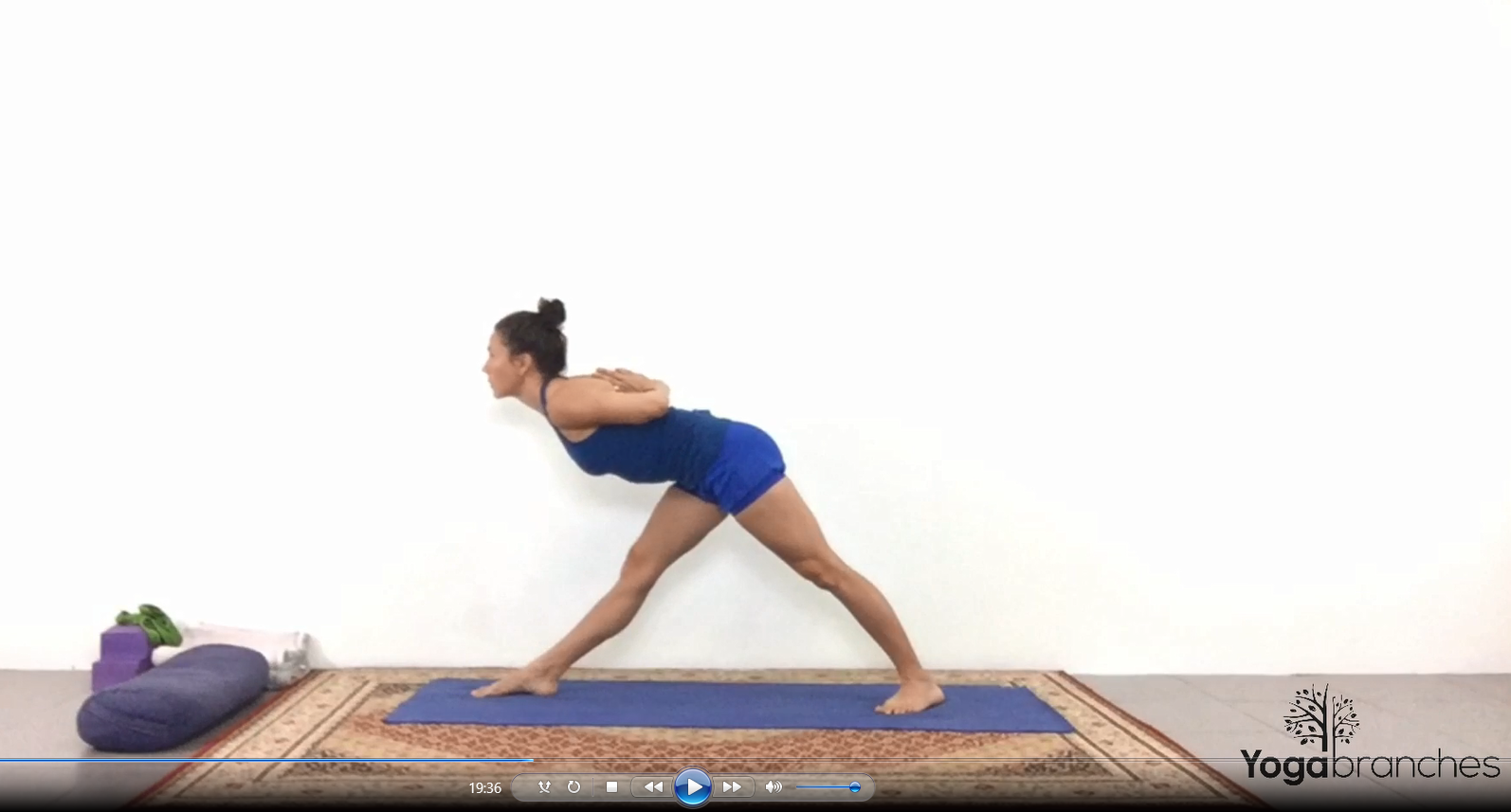
Be Accountable to Someone Other than Yourself
You do not have to go this alone.
The yoga journey of a practitioner can be very lonely at times, yes we have to endeavor in svadhyaya self-study but nowhere does it say you have to do this alone in isolation.
You do not have to go this alone.
The yoga journey of a practitioner can be very lonely at times, yes we have to endeavor in svadhyaya self-study but nowhere does it say you have to do this alone in isolation.
Heck, we’ve had enough isolation during COVID-19 to last us a lifetime.
I’ve been lucky to be part of a close-knit community of teachers at the studio I teach, where we practiced together every Tuesday rain, hail or shine.
Knowing people were waiting for me, expecting me, kept me accountable.
I had a responsibility to my peers and was not going to let them down.
Have you got a friend you can practice with each week to help keep you accountable?
If you’re feeling the value of this already blowing your practice-wide open, you can take it one step further and join The Iyengar Home Yoga Practice Facebook Group for SO much more. Get all the insider tips and tricks, and connect with like-minded practitioners for advice and support. Join HERE
Not only will your friend keep you accountable and get you to show up…
You can share the practice. Share ideas for postures, inspire each other and show each other different ways to practice.
You can take turns offering poses, take turns leading the sequence, you can just keep an eye on each other get inspired as you do your own thing.
Practicing with others is exciting and energising and makes getting on the mat that much easier.
The energy of practicing with others as you would know if you have done a yoga class is powerful.
I lead a live practice every week online, to bring the community together, to help keep you and me alike accountable.
I’d love you to join me. Click the HERE to find out how.
xxx
K8

Need = Benefit = Motivation
Before we even get on the mat our thoughts are often something like…
‘I have to practice’,
‘I am so stiff and should practice my yoga’ or
‘If I don’t practice I’ll never improve’
Before we even get on the mat our thoughts are often something like…
‘I have to practice’,
‘I am so stiff and should practice my yoga’ or
‘If I don’t practice I’ll never improve’
This kind of thinking sounds like a parent trying to make a child do their homework or clean their room.
Where is the benefit, the reward, and the motivation?
Today I want to share with you the most simple and effective way to get motivated to practice that will meet deep needs and help you tap into yourself even before you have got on the mat.
If you’re feeling the value of this already blowing your practice-wide open, you can take it one step further and join The Iyengar Home Yoga Practice Facebook Group for SO much more. Get all the insider tips and tricks, and connect with like-minded practitioners for advice and support. Join HERE
I first have a confession to make. I have said something along these lines to myself many times. ‘I have to practice’ followed by a whip-cracking sound.
Remove the ‘have to’ from the sentence and replace it with ‘want to’ and already you will be a few inches closer to getting on the mat.
But I’m not done yet!
Here is my 2 part strategy to help you identify why you want to practice, understand how it is going to meet a deep need, and instantly feel motivated to practice.
How do you feel after your practice? List out how you feel after you do yoga. I am guessing you might have some of the following words on your list. Relaxed, Energised, Balanced, Physically Strong, Mentally Clear, Agile etc
Each of the feelings is linking directly to the need you have. Let me explain. If you feel relaxed after yoga that is because you have a need to unwind. If you feel strong in your body, that is because you have a need for muscular connectivity in your body.
When we connect to why we are doing yoga, what we hope to gain from it (the benefits) and how we feel after we practice it is much easier to get on the mat and practice compared to whipping ourselves with ‘haves’ and ‘shoulds’
Discipline does not have to be a dirty word, find your discipline through a deep desire for wellbeing.
If you want to dive deeper into this A = B = C strategy. I step you through in detail in this video.
xxx
K8

Change is as good as a holiday
A repetitive practice can lose our interest like the latest app on the market. Before you know it you are looking for another app to replace the last, yet coming up with new sequences daily is not as easy as downloading a new app.
A repetitive practice can lose our interest like the latest app on the market. Before you know it you are looking for another app to replace the last, yet coming up with new sequences daily is not as easy as downloading a new app.
Yes, we want to have a variety of different sequences to practice but can I share with you a few other tips that will help to change up your practice from repetitive and boring to fresh and interesting?
Being a yoga teacher, I have learned the art of sequencing and creating new sequences daily, but when I first started practicing at home this was not the case.
By accident one day I practiced in a different space in the house because my partner was where I would normally practice and I learned a lesson I will never forget. Read below for this life practice tip.
If you’re feeling the value of this already blowing your practice-wide open, you can take it one step further and join The Iyengar Home Yoga Practice Facebook Group for SO much more. Get all the insider tips and tricks, and connect with like-minded practitioners for advice and support. Join HERE
Short of coming up with a new sequence every day have you tried:
Practicing at a different time of day? The body is very different in the morning than to the afternoon, doing the same sequence at a different time of a day will be a whole new experience.
Practicing in a different part of the house? Explore other places to practice that will inspire you to use the furniture or wall fittings to change up the approach to the posture in the same sequence. For example, the stair banister, corner of the wall, coffee table, etc can bring a new experience to the same old pose.
The mind like new shining objects to focus on, it wants to be excited and engaged, these are just a few ways you can bring freshness to your practice and engage your mind in the asana.
Make your practice, explorative and the mind will follow.
When I moved into a different house, I created this video. I was so excited to explore all the different spaces I could practice. Watch it to get some tips for your own home exploration.
xxx
K8

Life-changing tips to up-level your practice
We find it hard to get on the mat because we are so used to a teacher telling us what to do we are not empowered to take it into our own hands.
Furthermore, we think a home practice needs to have the variety, length, and depth of a class and fall into a pit of despair and feelings of inadequacy.
We find it hard to get on the mat because we are so used to a teacher telling us what to do we are not empowered to take it into our own hands.
Furthermore, we think a home practice needs to have the variety, length, and depth of a class and fall into a pit of despair and feelings of inadequacy.
We might have been doing yoga for 1 year or 9 years and don’t have the confidence to put together a sequence of poses, let alone something as comprehensive as what we have done in class.
Let me tell you a right now… your expectations are wrong and you are going wrong and there is another way.
If you’re feeling the value of this already blowing your practice-wide open, you can take it one step further and join The Iyengar Home Yoga Practice Facebook Group for SO much more. Get all the insider tips and tricks, and connect with like-minded practitioners for advice and support. Join HERE
Just aim for a little excitement about what you are going to practice so that in the first place you feel inspired to get on the mat practice.
What you practice can be very simple poses, it can be challenging poses, it can be anything, but first and foremost you must be interested and engaged mentally in what you are about to do.
So we have to find excitement. We have to get excited! We have to be interested, this is not hard but is a step not to be missed.
Set aside some time to get inspired, get some ideas, get excited about something you want to explore in your practice.
We have to find our curiosity.
Recall a class you did and choose a couple of poses you want to explore again.
Look at some books with pictures of asana as select a few that you are curious to attempt
Review notes on a workshop you did to find something of interest you want to revisit.
Approaching the mat with a curious, interesting, explorative mind will get you on the mat easier.
Just start with 3 poses and let the curiosity of your mind explore and discover. Be interested!
xx
K8

Make a Plan No Matter How Small
As a building that is being built needs scaffolding, a yoga practice that is being established needs a plan.
But what kind of plan?
There are many things we can plan for our practice, like what we are going to do, how we are going to do it, who, when, where etc.
As a building that is being built needs scaffolding, a yoga practice that is being established needs a plan.
But what kind of plan?
There are many things we can plan for our practice, like what we are going to do, how we are going to do it, who, when, where etc.
The most important plan to make is WHEN you will practice.
I know it sounds simple, but the biggest hurdle to not practicing is not prioritising the practice time in our already busy day.
If you’re feeling the value of this already blowing your practice-wide open, you can take it one step further and join The Iyengar Home Yoga Practice Facebook Group for SO much more. Get all the insider tips and tricks, and connect with like-minded practitioners for advice and support. Join HERE
If we do not prioritise the time to practice, if we do not schedule the time to practice in our calendar like we would an important word meeting, it will not happen!
When I was first establishing yoga practice at home I would go about my day and ‘think’ I will do my yoga when I get h
If we do not prioritise the time to practice, if we do not schedule the time to practice in our calendar like we would an important word meeting, it will not happen!
When I was first establishing yoga practice at home I would go about my day and ‘think’ I will do my yoga when I get h
If we do not prioritise the time to practice, if we do not schedule the time to practice in our calendar like we would an important word meeting, it will not happen!
When I was first establishing yoga practice at home I would go about my day and ‘think’ I will do my yoga when I get home from work.
This is not good enough! I never succeeded in this way to practice.
Below I am going to propose 2 simple, quick but very effective things to do to ensure you make your practice.
I do this before bed every single day. Before I lie down and battle to fall asleep, I will set on the edge of my bed in an upright position, so my mind is alert and fully conscious of what is happening. SO that I am not deluding myself or forgetting what I am committing to doing.
I will set my alarm for the time I am going to wake up and practice. If I am not doing the practice first thing in the morning, I will set the time in my calendar with a reminder like I would a meeting.
Take just 3 minutes to decide right then and there what will be the focus of your practice. Will it be backbends, inversions, restorative. Just decide on a focus so that when you get on the mat you at least know what you plan to do.
There you have it!
One of my top tips for getting on the mat to practice easier for you 🙂
Apply these tips to maximize your time and make the most of your practice so you can feel good and reap the benefits of your yoga practice off the mat.
xx
K8

'Assessment' Doesn't Have to be a Dirty Word
Yep, I said it… ‘Assessment’ is getting a bad wrap.
People are finding it so stressful and overwhelming and not enjoying the experience that ti’s giving ‘assessment’ a bad name.
Yep, I said it… ‘Assessment’ is getting a bad wrap.
People are finding it so stressful and overwhelming and not enjoying the experience that ti’s giving ‘assessment’ a bad name.
Today's discussion is all about how ‘Assessment’ got a bad name because people have had a bad experience. Whether that bad experience was self-inflicted or inflicted on you by someone else this is ultimately why ‘assessment’ has become a dirty word.
In the video below I’ll talk through why we get so stressed over assessment and begin to question why we are doing yoga, is it for the certification or because we love it.
I will you remind you of the benefits of going for assessment (if you have forgotten because of bad experiences)
I want to look at what we can and can’t control in the assessment process
And how you can start making conscious and smart choices about your approach so you feel empowered and remove some of the stress we create
I also want to show you at the end how to create fun and challenging sequences that shakes you out of the assessment syllabus and box we can put ourselves into.

How to Create a Challenging, Dynamic & Interesting Home Practice
That’s a big mouthful and there is a lot to be said on all of these challenges in our home practice, but I know you are time poor and want some tips you can implement immediately into your practice to grow it.
That’s a big mouthful and there is a lot to be said on all of these challenges in our home practice, but I know you are time poor and want some tips you can implement immediately into your practice to grow it.
That’s why I hosted a video masterclass. I wanted to give you a few tips you can take away and apply and get results. WATCH VIDEO BELOW
When we start a home practice we think it should be easy enough, ‘I know how to do the poses in class I’ll just do them at home’. But wow is there so much more to it than that.
A Challenging Practice
Many of us desire a practice that is challenging, like a challenging class where we get pushed to our limits and attempt poses we have not done before or that are new to us.
Let's be honest, your home practice is never going to leave you feeling how you do after a class. There are so many factors that are different mainly you don’t have an experienced teacher with a well thought out sequence driving you, you don’t have the energy of all the other students in the room… and the list goes on.
That aside there are things you can do to increase the challenge level in your practice but have a realistic expectation of what you can achieve on your own.
TIPS for a Challenging Practice
Be clear on your intention for your practice every time you practice
Plan your practice write the entire sequence out and know how you are starting what is going to lead you to the challenging poses and how you are going to wind down.
This energy is achieved in class because a teacher holds you in a pose longer and you repeat the pose more times than you are comfortable with. So you have to do just that
TIPS on Note Taking on a Class
Get the order of poses right because this is going to give you clues to know what poses prepare you for those more challenging poses.
Make notes on a few keys instructions given in the poses
Make note of the NOT poses in the sequence, all the bits in between the actual poses. These are preparing you for the poses.
A Dynamic Practice
As for a dynamic practice, it is not one that is band bang bang from start to finish. It's a practice that has quite parts, loud parts, stillness and movement.
We need to consider the sequence as a whole and how including different properties within the sequence will stimulate growth in our practice.
TIPS on creating and incorporating Vignettes
Light on yoga is a great reference because the way the poses are ordered in the book can give you some clues and ideas
Create groups of 3-5 asana you can do more but they tend to lose the dynamic quality
Sprinkle them throughout your sequence to boost the energy of your sequence or when you feel your practice is stagnant.
Repeat them and do them in quick succession
Learn new ways to enter and exit poses
Lastly, you don’t have to always practice them quickly, the beauty I find of the vignette is how they create links and layer poses so we can go deeper in them, this is more understood when you do a vignette in slow motion.
An Interesting Practice
Is achieved by having a diverse range of resources to support your home practice.
I’m talking about pdf sequences, video sequences, audio sequence, class notes, workshop notes, pranayama, restorative, you want a whole range so that there is something for every day of the week depending on how you are feeling and what you need.
What also keeps out practice interesting is staying interested in it. Practicing yoga, stilling the fluctuations of the mind and keeping our focus on our body and breath throughout the practice is incredibly interesting… if you can do it.
it takes practice and…
TIPS on Staying Focused for an interesting Practice
On the mat - Feel your body in the asana instead of just doing the asana. We are a doing society, so when you are on the mat can you shift from doing mode to observing and feeling mode?
Use the tools of breath and alignment help to bring concentration to the body so can feel the wholeness of the pose rather than just a mechanical doing.
On the mat practice with effort and discipline, then pause, observe and study yourself and, then at some point we can learn the quality of surrender.
WATCH THE FULL MASTERCLASS BELOW
GET ACCESS TO THE HOME YOGA PRACTICE MEMBERSHIP HERE

Assessment Strategies
In this video I share with you some strategies I do to make my assessment journey less stressful and more enjoyable.
In this video, I share with you some strategies I do to make my assessment journey less stressful and more enjoyable. An Iyengar yoga practice as we know takes discipline and I want to share with you some strategies to be more disciplines in your practice and assessment journey.
So much of our stress about assessment is around the things that are out of our control like, who will be on the assessment panel, not being able to perform all the asana picture-perfect, not knowing what asana will be given to us on the day and the list goes on.
What I like to focus on is what I do know and what I can control and that’s my practice and study and how I can best prepare for assessment.
In this video, I’ll step you through my 3 favourite strategies for a more enjoyable assessment journey.
Planning your practice and allocating time specifically for assessment practice
Setting goals and mapping out how what you need to do in the months leading up to assessment
Building a team to support you in your preparation
Join the Peer Practice Group click the button below.

How to Stay Focused in Your Iyengar Yoga Practice
What distracts you when you are practicing?
Is it your pets, your kids, your phone, your mind?
The big take away for today is…
It is what you do before you get on the mat that is going to help keep you focused in your practice.
What distracts you when you are practicing?
Is it your pets, your kids, your phone, your mind?
The big take away for today is…
It is what you do before you get on the mat that is going to help keep you focused in your Iyengar yoga practice.
1. Create physical space for your practice
Creating a space is integral to making your practice happen and helping you stay focused in your practice.
Choosing a space that is tucked away from the hustle and bustle of household activity to help to keep the practice more focused
Tell the housemates/family members what the space is for and how you would like it respected. Don’t assume they know or understand the importance of the space to you.
2. Create physical space for your practice
Our mindset, our mental approach to our practice is critical to what the practice looks like. If we are beating ourselves up to do it, with lots of ‘I have to’s’ and whip whip whip, there ain’t much chance of it going smoothly, enjoying it and it happening again very soon.
When I was in Pune, Raya was talking about wooing your practice, sending it a love letter. Coaxing it gently and wooing like something you love. This image really stuck with me.
Write your practice I love letter. Literally, sit down and write all the things you love about your practice and why you want to spend so much time with it.
If we treat our practice like a lover or partner we have to make time for them... right? When your partner is talking to you, you listen with full attention to the details of their story, so do the same with your practice, listen to your body in your practice, be curious about what the asana are telling you.
Loyalty. Be loyal to your practice. Make a commitment that when you are practicing your are going to be loyal to it, not cheat on it with your mind somewhere else, not cheap on it by thinking about another lover:)
3. Diversify your sequences
A big part of why we lose concentration and focus when we are practicing is because we a practicing like robots, mechanically and the same old asana that we are comfortable with over and over again.
Have a range of sequences (not all created by you) at hand, to follow. This might be illustrated PDF’s, audio, video etc. You will be alert and listening for the cues in the sequence simply because it won’t be familiar to you and this will in itself keep you more engaged.
Practice with a friend and take turn leading or alternate calling the pose. Having someone else to practice with can simply create energy that keeps you more focused and on your mat for longer and you will get ideas for things to practice by seeing what they are doing.
Start to include unfamiliar poses into your practice. Asana that are within your league but that you are not confident with, ones that you have to think about to get into them and consider your move.
In the video below I go into all the details of staying focused on the mat. Watch it now.
If you want more tips and ideas for creating sequences CLICK HERE

2 Step Process to Find Your MoJo on the Mat?
In this blog I’m going to help you find your motivation to GET ON THE MAT in the first place.
When I ask my community what’s the biggest challenge in their Iyengar yoga practice at home, often people say “getting on the mat”
Today I’m here to help you find your motivation to GET ON THE MAT in the first place.
Motivation is there when you know the benefit. For example I am easy motivated to lie on the couch and read because it will meet my need for entertainment & relaxation.
You know doing yoga is good for you and once you have done your practice you are going to feel so much better for it. But it requires a fair bit more effort than lying on the couch with a book and the benefits and not always immediately felt or known.
This is why we have the motivation issue. If you don’t have a clear intention for why you are getting on the mat and the benefits are not clear, the motivational point is missing.
So let me take you through a 2 step process that will arrive you at your motivational point.
A = B = Motivation
I want you to find your motivation for getting on the mat.
17 Years ago I started yoga because I had knee surgery and needed rehabilitation. Months had passed after the surgery and for a 20 something, my knee was not working how it should have. I was looking for mobility.
You can probably guess now what A and B are.
A = Problem
B = Desire/Need
Problem = Desire/Need = Motivation
Here is the 2 step process. Get a pen and paper and write this down as we go through.
A. Ask yourself what is the problem? Let me give you a few ideas in case it is not obvious to you.
You are stressed and over worked
You are exhausted and have not energy
You have tight hamstrings
You find it hard to fall asleep and don’t sleep well
Get the idea?
B. Want do you want/desire?
You are stressed and want to feel more relaxed and chilled out and to be able to switch off
You are exhausted and want to restore your energy
You have tight hamstrings and want more flexibility
You don't’ sleep well and want to fall asleep more quickly and sleep deeply.
There is the answer to MOTIVATION. You have to have an intention, something you are working towards and that will give you the motivation to get on the mat in the first place.
I speak in more detail here about Motivation, Prioritising Time & What to Practice in this video. Check it out!
Want more help with your home yoga practice become a members of Yogabranches HERE

3 things about sequencing that will make a difference to your home practice
I want to share with you 4 things about sequencing that will make a difference to your home practice
I want to tell you not just how to create a sequence but a sequence you actually want to follow, that you can’t wait to do, that makes you sweat and has an impact on the rest of your day.
Let's start at the very beginning (i hope you just sang that as Julie Andrews does in Sound of Music)
Sequencing is the jam/cream (depending on which you prefer) in your practice. I’d go a melting moment.
The bottom biscuit is discipline, the cream/jam is the sequencing and the top biscuit is your understanding of the asana. Let’s talk about Iyengar yoga sequences in your home practice.
If you have sequencing nailed, you are a third the way there with your home practice.
A consistent home yoga practice comes down to awesome sequencing. You might know a bunch of asana and have the discipline to get on the mat, but if you don’t know how to put those asanas together to create a sequence that
Is satisfying
Make you feel good
Challenges you
Inspires you
You will not be consistent in your practice.
I want to share with you 3 things about sequencing that will make a difference to your home practice
I want to tell you not just how to create a sequence but a sequence you actually want to follow, that you can’t wait to do, that makes you sweat and has an impact on the rest of your day.
Let's start at the very beginning (i hope you just sang that as Julie Andrews does in Sound of Music)
Let´s start at the very beginning
A very good place to start
When you read you begin with A-be-see
When you sequence you begin with A-r-c
A Sequence Arc is much like a story. It needs a beginning, middle, and end.
The Beginning is like setting the scene. Use this part of the practice to bring awareness to the body and minds current state. It is an opportunity to ease in and connect and engage your mind with your body. Start with easy poses that warm the body up.
The Middle is the bulk of your practice. Use this part of the sequence to practice more active and dynamic asana. Here is your chance to go deep into the asana, and peel back the layers. Include challenging asanas that demand your attention and focus.
The End is where we close the practice like a well-rounded story leaving the reader satisfied and wanting to come back for more. Use this part of the practice to wind down from the climax. Include asana which quietens and cool the body and mind.
As well as knowing how to create sequences that are well rounded we also want to be able to Tailor Sequences to meet our conditions.
Tailoring a Sequence to your conditions.
We need to consider our age, the season, ability, wellbeing, time of day and duration of practice.
In order to create a sequence that responds to how you are feeling follow these steps.
First, start by checking in with your body and mind and determines its current state.
Identify where you want to have your focus in your practice and set an intention.
Create a sequence of poses that compliment your intention
Practice each asana with your intention in mind
For example, if you have tight shoulders and upper back, include asana which releases and feel good for this area and practice each with that part of the body in mind.
It’s so easy to practice the same thing or similar asana each day, but boy is that boring and uninspiring and if this is you, have you noticed your practice hasn't progressed?
Here is one way to create a Challenging Sequence
Choose a challenging asana you want to reach at the climax of your practice. I like to call this the ‘Hero’ or ‘Champion’ pose.
List our asana that will help prepare you to get to your ‘Champion’ poses
List out counter poses for the ‘Champion’ pose. (for example if it is a backbend what do you need to do afterward to bring your body and mind back to neutral)
Slot your inversions in where appropriate
And there you have the starts of a more challenging sequence.
I recently created a 3 Part Video Series which goes into all the details about what I have suggested above and so much more.
In these videos, I literally step you through from A-Z of creating sequences for beginners to more experienced practitioners.
I even create sequences within these videos that you can copy down and use.
If you want more support in creating sequences for your home practice you can check out the videos I created here.
This is some feedback I have received from these videos
"You teach with such clarity and simplicity I feel, even, viewing the video replay is so very worthwhile!! I am loving every moment !! Thank you so much!!" Barbara Katz
"The nugget I’ve enjoyed most so far is the workbook 101 asana stick figures. What a time saver and a great way to compare the shapes of the poses when planning a sequence. Thanks!" Rebecca Salinas Wallace
"Main thing... watching how easily you could take a few poses from each section and create a focused sequence. You have inspired me." Debra Wheeler
The Video Sequencing Series is included in Yogabranches Home Yoga practice Premium Membership. Join today and access all the videos and more

4 Tips on how to keep up your practice when you travel
I want to share with you my 4 Essential Tips for travel/holidays & yoga so that you can practice everyday too while your are on holidays.

When I’m on holidays…
I can say, I practiced every single day!
I want to share with you my 4 Essential Tips for travel/holidays & yoga so that you can do your Iyengar yoga practice every day too while you are on holidays.
Just for the record, I don’t make this stuff up… these exact 4 things I’m sharing with you today are exactly what I did for this last holiday I just took.
So let us dive in
1. Mat, Brick, Belt
I don’t leave home without them. I don’t have a travel mat, rather I like to take a big suitcase and then I can fit a brick and strap too… I prioritise yoga in my life.
It’s a lifestyle choice I have made and will not compromise on. Some people pack makeup, hairdryer, etc that’s a lifestyle choice they have made.
Have you made a firm commitment to making yoga part of your lifestyle? It’s pretty essential if you really want to make it a daily thing.
2. Practice First Thing
Holidays (while we all think we are going to relax and read) can get pretty busy, especially if you are holidaying with a family like mine!
They like to do everything and all together… let’s just say if you want to do yoga as well, you have got to do it first thing while they are all waking up on their third coffee.
Don’t say “I’ll do it this afternoon” because come 4pm an opportunity for a walk, a beer, game of cards, or connection with a friend/family will arise and you probably have a firmer commitment to all of them above yoga so you know which one you are going to choose.
And no one wants to be the holiday pooper “Sorry I can’t go for coffee/beer/swim now I have to do my yoga practice”
3. Practice Off the Mat
I did a really unsatisfying practice one morning on this last holiday and then we were off for the day adventuring… so I did yoga while we were on the beach… now that is satisfying.
Practicing yoga off the mat is like a breath of fresh air. It offers freedom. Get out of your comfort zone, look around see what props you can use at the beach or park. Check out the yoga videos I created on my last holiday… they are fun!
Watch the Video below!
4. Yoga Sequences
Have a few sequences on hand so you are efficient with your limited time. It’s a holiday remember, so give yourself a holiday from thinking about what to practice. Have some PDF’s printed or if you have wifi subscribe to online yoga videos (I have heaps if you are interested click here).
That way you get out of bed, roll out your mat and practice, every single day you are on holidays.

Balancing Life, Work & Yoga
We all know that teaching yoga and making a full time income from teaching is near impossible and we have to supplement the teaching with another job or business or otherwise we are teaching 20 classes a week and and thats just not sustainable.
In this video I will share with you some sustainable ways to balance it all.
We all know that teaching yoga and making a full time income from teaching is a yoga challenge (near impossible) and we have to supplement the teaching with another job or business or otherwise we are teaching 20 classes a week and and thats just not sustainable.
And we all know that teaching yoga takes so much more than just rocking up to a studio to teach a class for an hour.
It requires practice and study and dedication and time.
So how do we juggle all this with work and families and and and?
It’s hard to juggle everything all at once, all the time. I’ve tried that and to be honest, I failed and I suffered and my family suffered and my practice and teaching suffered.
I was stressed, overwhelmed, disconnected from my loved ones and not having any fun.
I have learn a lot since then and that’s what I want to share with you today. How to keep all the balls in the air.
I have a bunch of good habits I have implemented into my daily life that help keep everything in balance and in this video I will share with you those good habit.
But you need to do the work, they are things that will take some effort effort to start doing and to make regular in your daily life, but once you implement them and see results they will be easy to keep up.
In this video I will share with you
Recognising the warning signs
The tools I use to keep the balance
Creating a practice that serves YOU
My practice schedule
The 1 thing I did that really shifted the balance for me
Watch the video below for step by step action you can take now.

Overcoming the 3 most common yoga challenges we face in our home practice
I want to share with you the most common challenges this community comes up against with their home practice and some tips and ideas to overcome these challenges.
There are many challenges to maintaining a daily yoga practice and I have organised these hurdles into 3 categories.

I really wanted to call this blog post, how to have your cake and eat it too. But SEO didn’t like that title, so i’ve popped it in here as a sub title:)
I want to share with you the most common yoga challenges this community comes up against with their Iyengar yoga practice and some tips and ideas overcome challenges.
There are many challenges to maintaining a daily Iyengar yoga practice and I have organised these hurdles into 3 categories.
The challenge of getting on the mat in the first instance
The challenges presented by our physical bodies
The challenges that arise when you are on the mat
I am no stranger to these challenges, but I have found a few tricks that help to overcome them and I’m keen to share them with you.
1. The Challenges of getting on the mat include:
Making time
Being disciplined
Prioritising time
Too tired, lazy or unmotivated
Hungry or just eaten
Space and environment
Lacking the confidence to start, to know what to do or if you are doing it right
My 3 Tips are:
Set an intention for your practice, knowing why you are doing it, is going to make it easier to be disciplined.
Look at your schedule and plan a time each day that will be uninterrupted (or least interrupted) and free from meal times.
Confidence and ability will come with practice, just roll at the mat and do it.
2. The Challenges of the god given body include:
Whether you are born with a condition, the body has developed conditions due to lifestyle or you have injuries from an accident or illness, we are forced to stare them in the face when we practice yoga. There is no ignoring them, actually, that is the beauty of yoga, it forces us to hold a mirror and see what is happening.
I have had my fair share of injuries and know how frustrating it can be to not do something you could once do or to be up the back of the studio in a permanently modified pose.
My 3 Tips are:
Acknowledgment and acceptance of the condition/injury are necessary for making progress. The sooner we accept the situation as a learning opportunity the sooner we will make progress in our yoga.
Include in your daily practice a small routine of exercises/warm-ups or asana that you know improve the condition
Check in with your body, and practice with mindfulness, awareness, and intelligence.
3. The Challenges when you are on the mat include:
Distractions
Not being able to focus
Practicing alone which can lead to laziness
Creating sequences that are challenging
Including more advanced asana
Holding asana for long timing
Worry about doing it right
My 3 Tips are:
Make sure your phone is on airplane mode
Have a weekly/monthly plan that includes goals & challenging poses, it will help you to stay focused in the practice
Variety in the sequences you practice will keep you alert on the mat
All the Plan Your Practice Videos are available as BONUS videos in the Yogabranches Home Yoga Practice Premium Membership. Join today with a 14 Day Free Trial.
Watch the video training below for the full version of Overcoming Challenges in our Practice.

Yoga classes are to learn, Iyengar yoga practice at home is to explore
Attending yoga classes feeds our home practice. Here are my top 3 tips for what to do after a yoga class so that you can keep on learning beyond the class.
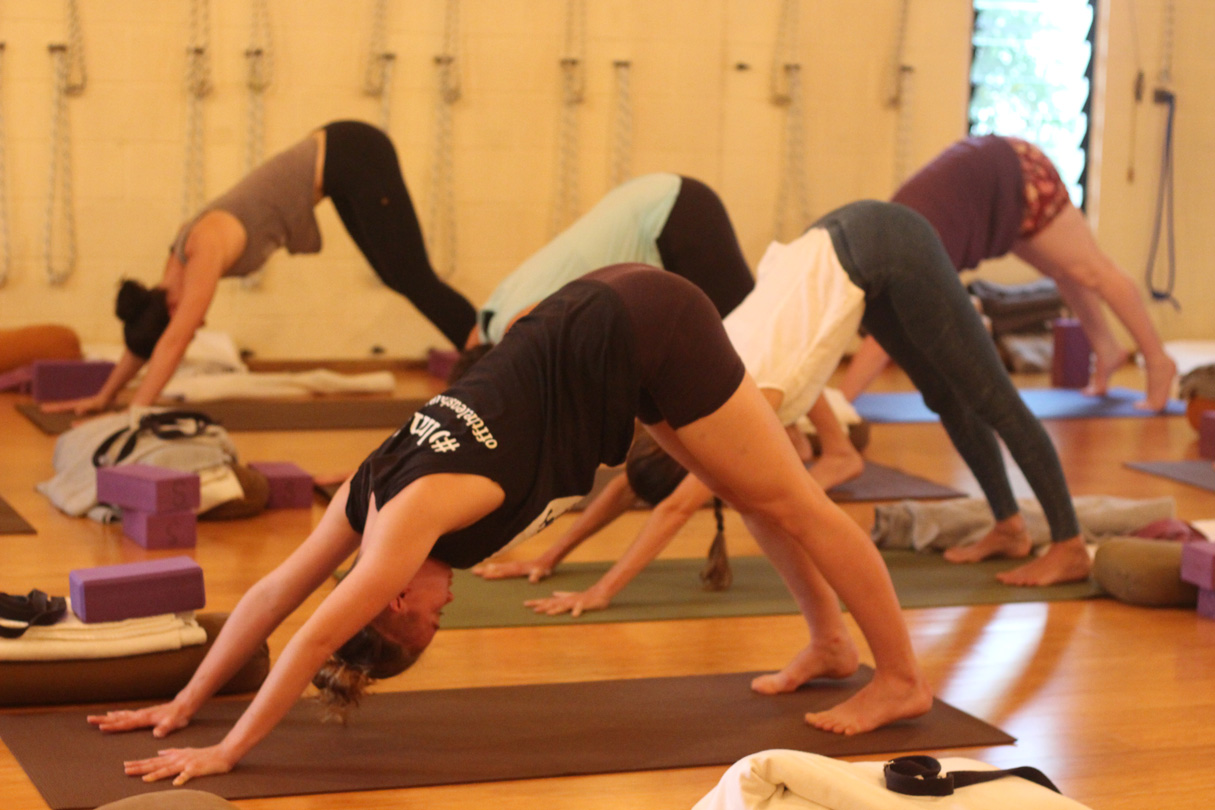
If I had to pinpoint ONE thing that has allowed me to go from no yoga practice to a consistent and regular Iyengar yoga practice it is because I continue to attend yoga classes weekly.
I know you might not have this luxury, but if you do…
Read on… this is critical for your home yoga practice
Yoga classes are to learn, home practice is to explore.
Attending classes gives me
something to chew on in my home practice
A focus in my home practice
Attention to detail so I don’t injure myself in my home practice
Confidence to practice alone
I went to a class today, I usually get in one class a week, it was one of the classes where the teacher packs it in. Give you so much information you can’t digest it all in class.
That’s why we practice at home, to go deeper in our yoga journey.
A home practice gives us space to explore what happened in class but in the comfort of our home.
How many times have you been in class and not been able to do a challenging pose, or just been intimidated by the audience factor, or has a case of comparisonitis and not been able to tackle the pose in class?
Home is the place to tackle it, there is freedom at home, there is no audience at home, you can fall on your face at home and no one will see.
At home we can develop confidence in our practice which we can then take back to the studio.
Ok but how you might be asking?
I wanted to leave you with my 3 top tips for when you do learn something, how to make the most of it.
As soon as I finish a yoga class, I
whip out my notebook and scribble down as much of the sequence as I can recall in the order it was taught
Write down as many tips or notes on any asana that resonated
If we used a prop in a pose write specifically what actions were connected to that prop
Practice, practice, practice.
If you need more ideas for your home practice. Try the Home Yoga Practice Membership 14 Day Free Trial

How to mix up your approach to practice so it's not repetitive and stale
There are some poses we know very well and we say for example’ ‘i know trikonasana’ and every time we practice it we do it the same way, with the same actions and we just practice it to practice it rather than I learn something new.
I challenge you to approach your ‘regular’ asana from a different angle, do them a different way, with a different focus and see what you might learn about yourself, your habit and tendencies in your practice and perhaps also in your life.
Watch this video for example on how to approach your practice.

It’s time to wipe the slate clean, find a new way to practice the postures and come at it like it’s the first time you have ever done the asana.
The other day I had an idea for a practice, something I remembered doing once in class, so long ago I could scarcely recall what the sequence was… but I wanted to revisit it.
So I started to do my iyengar yoga practice with a vague idea, but didn’t really know what I was doing. It was clunky and I fumbled my way through, but in the fumble, I explored and questioned and was curious and for all that it was messy, it was open and boundless.
There are some poses we know very well and we say for example’ ‘i know trikonasana’ and every time we practice it we do it the same way, with the same actions and we just practice it to practice it rather than I learn something new.
I challenge you to approach your ‘regular’ asana from a different angle, do them a different way, with a different focus and see what you might learn about yourself, your habit and tendencies in your practice and perhaps also in your life.
Here are a few tips to approaching an asana like you don’t know it.
List 3 different ways you can think of to do ‘the asana’
List 3 asana that has similar actions to ‘the asana’ in mind and practice them
Practice ‘the asana’ in a different order than you normally would.
What what you gain and what you lose in practicing the asana differently.
Watch the vide below on some inspiration to your approach to practice that I got when I was in Pune.
Do classes with me online. Start with a 14 Day Free Trial.

Tips on How to Enjoy Your Iyengar Yoga Practice
I don’t often give myself a long, deep, soothing savasana and I sure as hell deserve it.
This month I am making an extra effort to nurture my practice, to practice things I love and to love my practice and enjoy it.
And I want to share with you some audio recording of long deep savasanas that will restore your energy and have you coming back for more.

I don’t often give myself a long, deep, soothing savasana and I sure as hell deserve it.
This month I am making an extra effort to nurture my Iyengar yoga practice, to practice things I love and to love my practice and enjoy it.
When I was in Pune at the institute in January Abhijata spoke a lot about our approach to practice and enjoying our practice.
There were 3 keys points she spoke about I explain a little more about in the video
Don’t be rigid in your practice
Start your practice where you left off yesterday
Approach each pose like it is the first time you have done it
Check out a video of me talking about this in detail below…. direct from Pune, India.
Abhijata’s words inspired me to find as many ways as I can to practice savasana and to enjoy my practice.
Would you like to be lead into a deep savasana for total relaxation?
I’ve included the Savasana 5 Ways Pack as. free bonus when you join Yogabranches Home Yoga Practice Premium Membership. Start with a FREE TRIAL today.
I asked a friend and music teacher for advice on how to better support my kids with their daily piano practice.
She gave me the best advice which also applies to yoga practice.
Their practice had turned into a chore. They dreaded it as the time approached, struggled all the way through and it usually ended in a tantrum.