
Practice Point #8 - Yoga for Tight Shoulders
What yoga can I do for tight shoulders?
Today I want to answer a question from Sush in India.
What yoga can I do for tight shoulders?
This would have to be one of the most common questions.
I have tight shoulders too:)
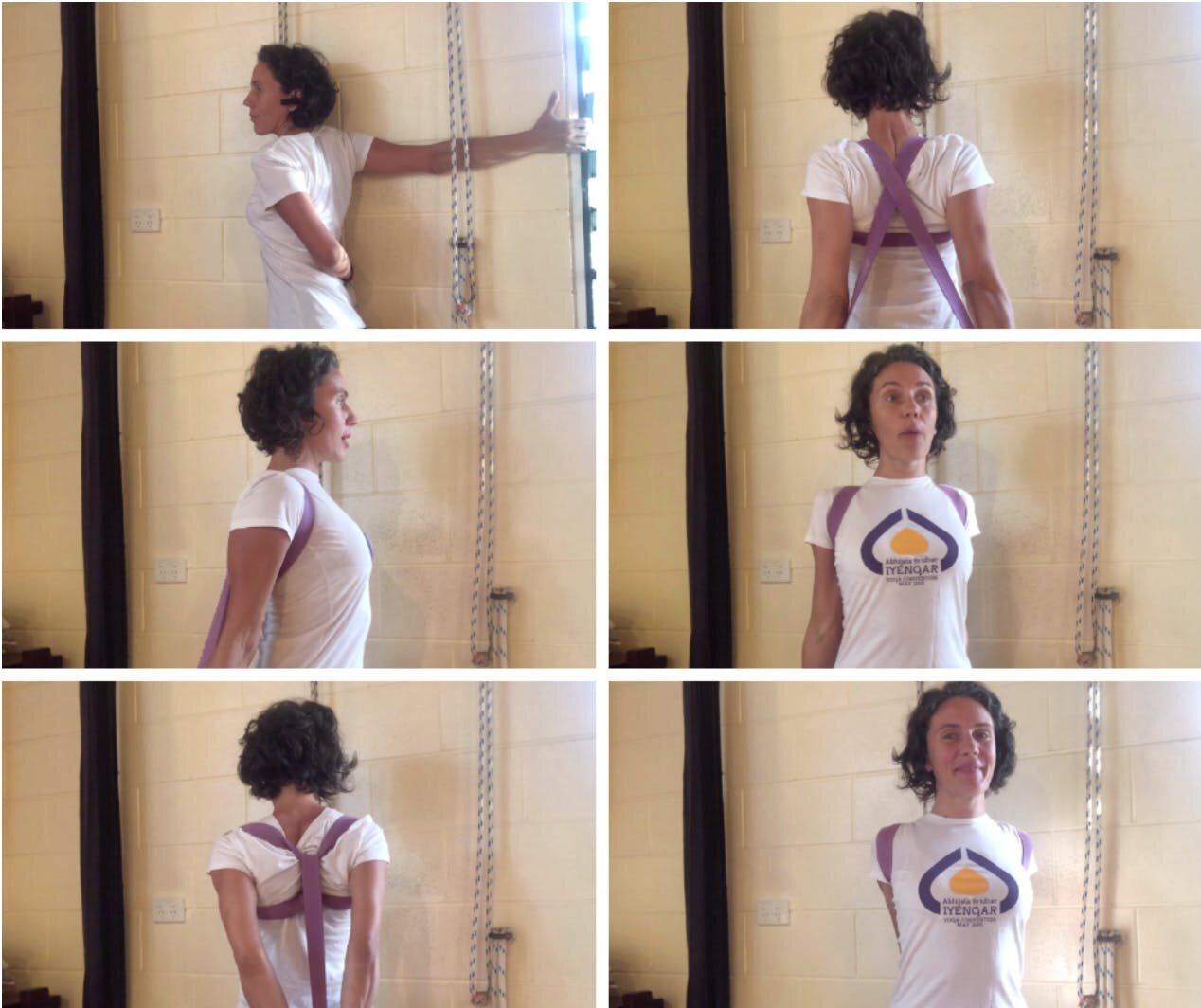
Here is a daily shoulder practice I recommend.

To understand how to use the belt like a harness you can watch the full video of this sequence in the Home Yoga Practice Membership. Find out more about membership HERE
If you would like to submit a question about home practice and receive the answer in these weekly Practice Points, you can below. Question related to specific injuries will not be answered.
Practice Point #9 - Yoga for Tight Hamstrings
Can you suggest some yoga asanas to help with really tight hamstrings?
In today's Practice Point we have a question from Sai in the USA.
Can you suggest some yoga asanas to help with really tight hamstrings?
I could write an essay on this topic, but I'll spare you and just suggest my top 3 recommendations.
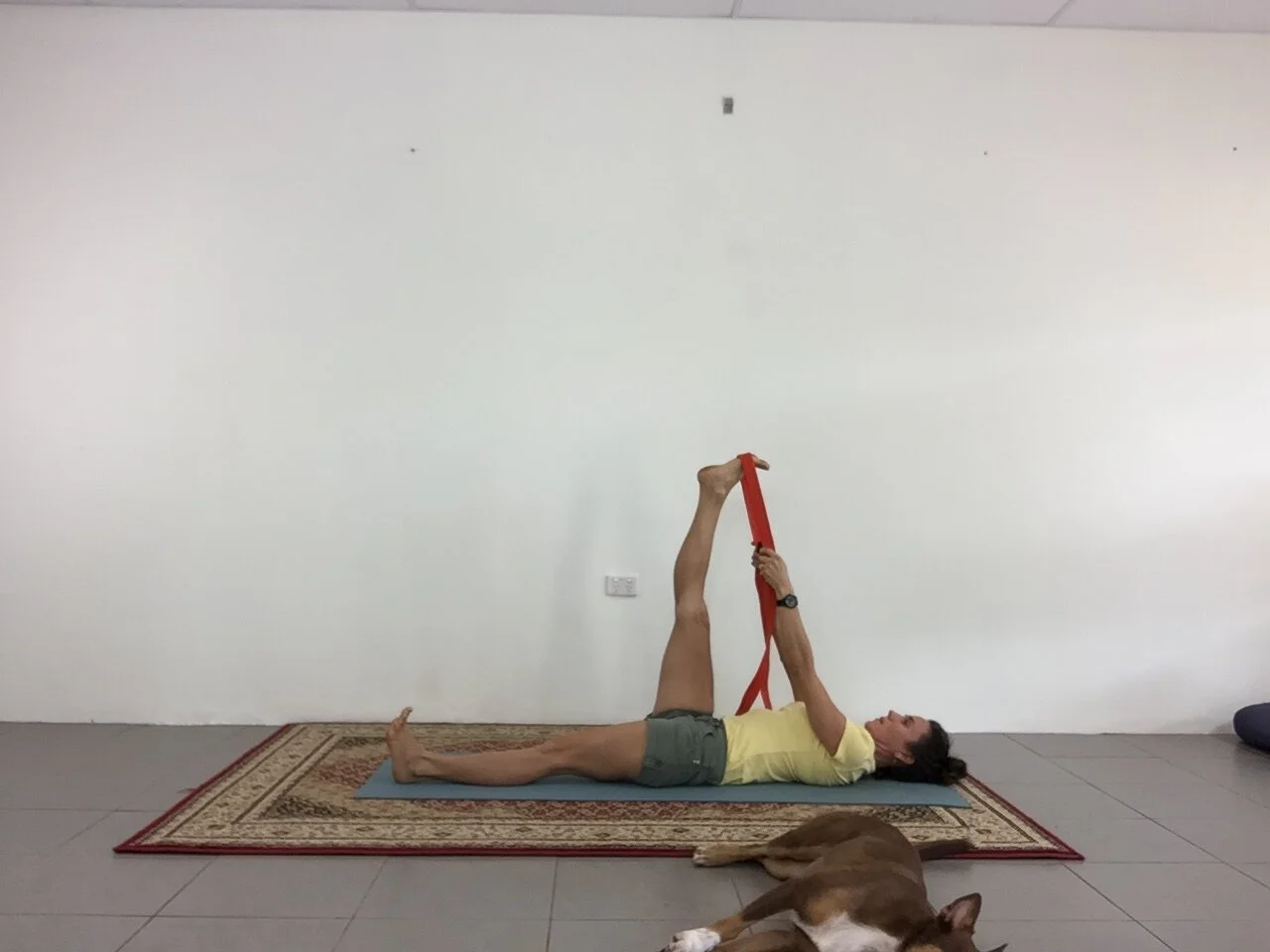
Supta Padangusthasana to stretch the hamstrings. if necessary keep the leg on the floor bent.
If you run or ride a bike on a regular basis this is contributing to the tightness...
Jathara Parivartanasana (knees bent) to release the tightness in the back and hips.

If you would like to submit a question about home practice and receive the answer in these weekly Practice Points, you can below. Question related to specific injuries will not be answered.
Practice Point #11 - Yoga Warm Up
What do you recommend doing as warm-ups before your practice?
I received a question from Debra in England. Her question is...
What do you recommend doing as warm ups before your practice?
I think this question is fascinating.
I have heard people talk about warming up before going for a run, but the idea of warming up before doing yoga is new to me.I have run about 6 times in my life when I was a teenager when I thought I was getting fat and thought going for a run would be the quickest way to burn the fat...
I hope you too are smiling at my innocence and ignorance.
So from my limited experience of running, I can see why we need to warm up because we go from being static to moving quickly and it is not easy for the body to go from static to moving quickly, hence if we warm-up, the transition will be smoother.
However, with a yoga practice, it is a 'whole' experience with a beginning, middle and end and each leads to the other so that the practice is seamless and transition is the practice.
If you recently did my 5 Day Sequence Creation Challenge this will be familiar to you.
Rather than thinking about a warm-up, think about a start to your practice that is gentle and there you have your warm-up.
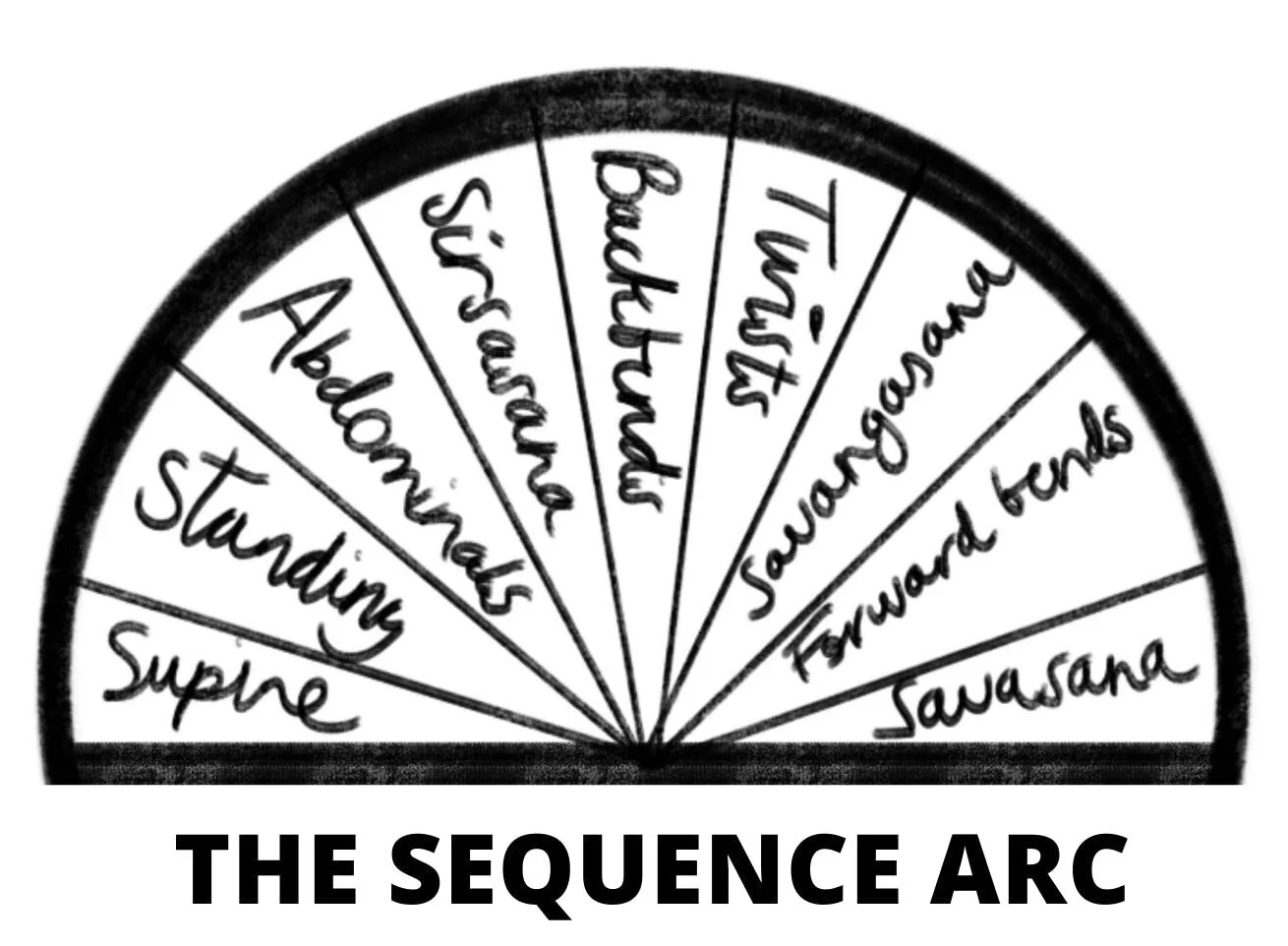
My Sequence Arc might also shed some light on how we don't need to warm up before a yoga practice, rather the warm-up is part of the practice.

If you would like to submit a question about home practice and receive the answer in these weekly Practice Points, you can below. Question-related to specific injuries will not be answered.
Practice Point #12 - Where to Begin
Where to begin with a home yoga practice?
I received a question from Sheila in Australia. Her question is...
Where to begin with a home yoga practice?
Thank you so much for asking this question. You are not the only one not knowing how to begin.
Here are a few suggestions for how to begin.
If you have done yoga classes at a studio I recommend doing at home what you did in class. Try and remember as much as you can of what you did in class and do the same at home. Even if it is only 3 poses, to begin with, this is the start.
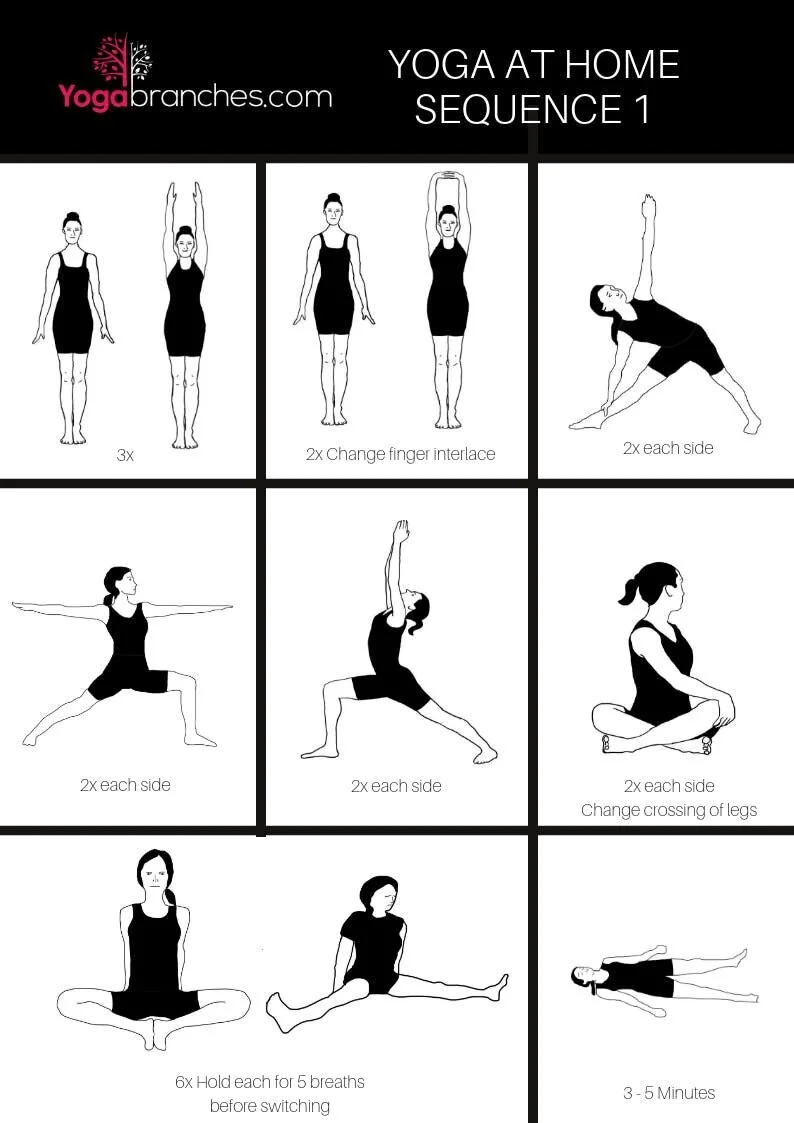
If you lack the confidence to start at home with what you have learned in class I recommend following sequences in an Iyengar yoga book. To help you out immediately I will give you a sequence here that is simple to follow.
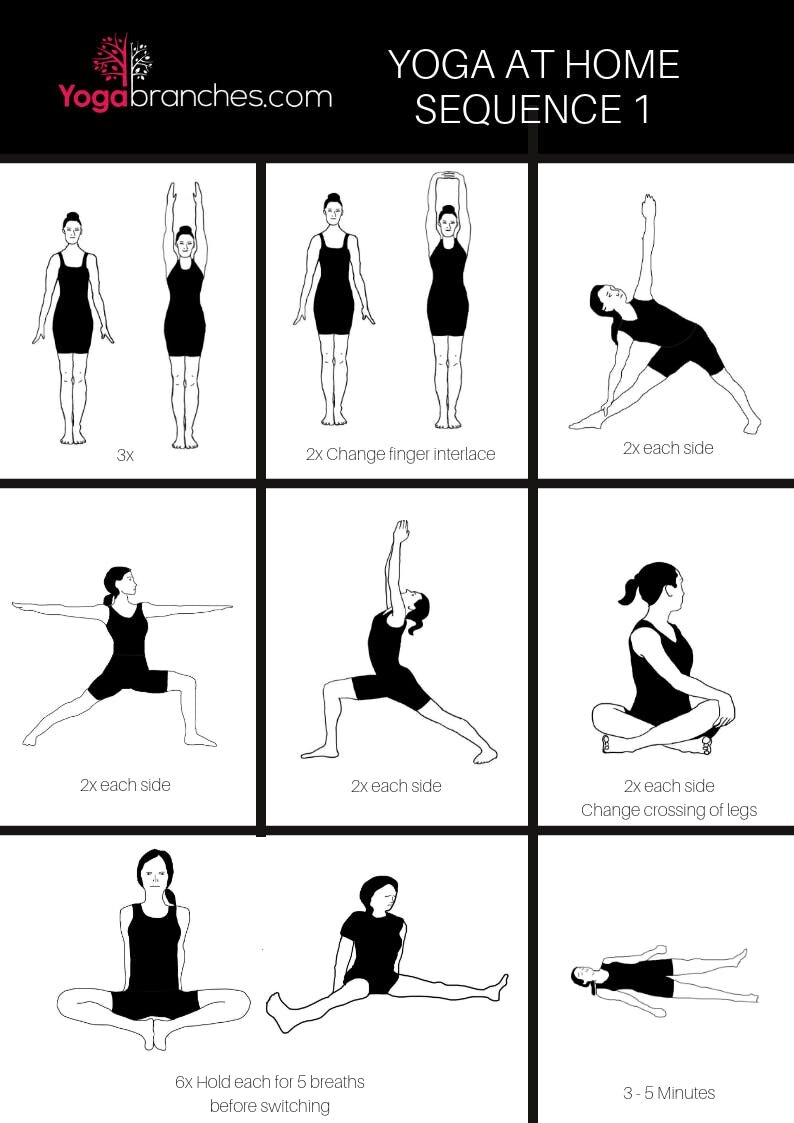
If you really want to be stepped through a yoga practice you can join Yogabranches Membership and start with the Beginner Classes where I step you through a whole class. JOIN MEMBERSHIP HERE
The Key to doing yoga at home is first to build your confidence, then you can build the repertoire of poses and it grows from there.
I hope that helps!
If you would like to submit a question about home practice and receive the answer in these weekly Practice Points, you can below. Question related to specific injuries will not be answered.
Practice Point #13 - Yoga for Good Posture
I sit at a desk all day working on homework. What is a good pose to practice on the mat that will help with sitting up straight at the computer? What is a prop that could be used to help have exquisite posture while sitting at a desk?
I received a question from Sheila in Australia. Her question is...
I sit at a desk all day working on homework. What is a good pose to practice on the mat that will help with sitting up straight at the computer? What is a prop that could be used to help have exquisite posture while sitting at a desk?
Another excellent question.
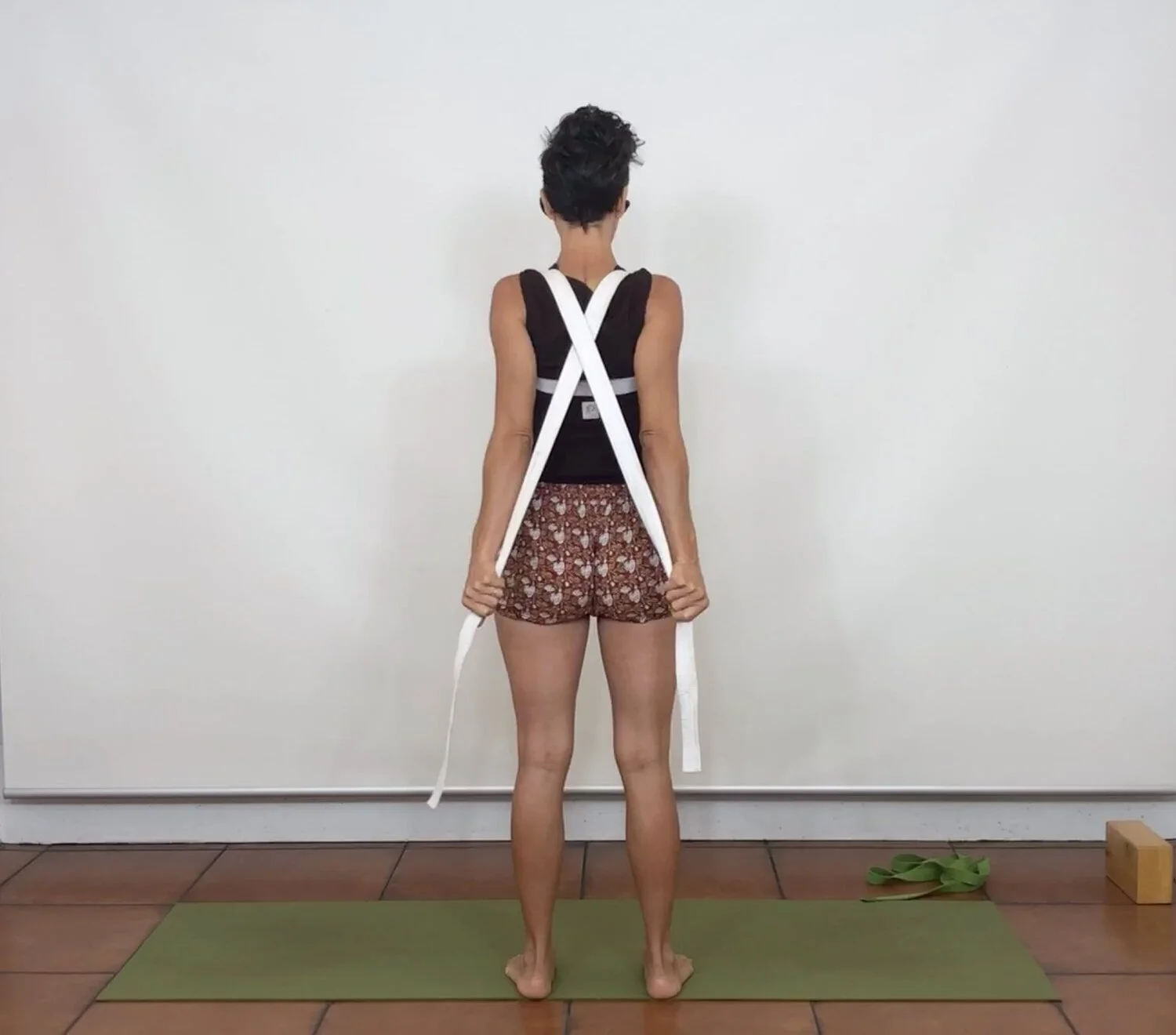
If I have a long day at the computer my favourite thing to do is wear a belt harness for 10 minute intervals, to help keep my posture upright.
Don't wear it for too long, just short spurts and remember to take regular breaks from the computer and do ardha uttanasana with the hands at the wall or gomukasana arms... these will also help.
Here is the belt harness. If the straps are long enough you can tie it off at the front so that you can free your hands for the keyboard.
I like to sue a karate belt because it is broad and long.

If you would like to submit a question about home practice and receive the answer in these weekly Practice Points, you can below. Question-related to specific injuries will not be answered.
Practice Point #17 - Kapotasana
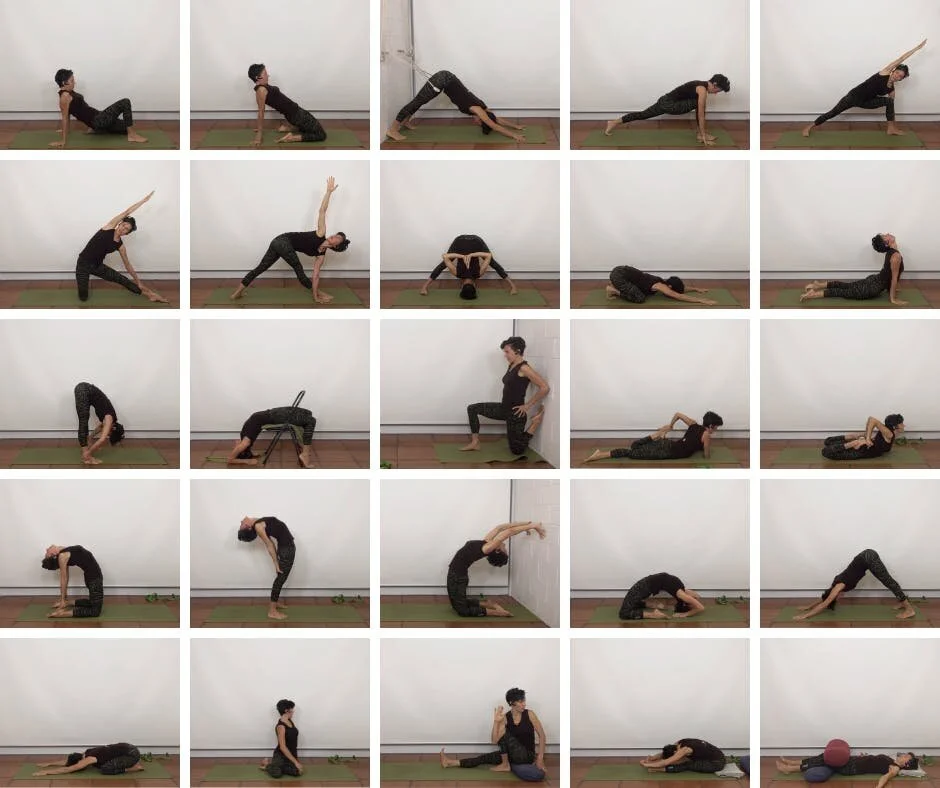
Can you give a sequence to work towards kapotasana?
I received a question from Filipa in Portugal. The question is...
Can you give a sequence to work towards kapotasana?
Kapotasana seems to be the flavor of the month, Filipa is not the only one to request a sequence working towards Kapotansana.
So here it is.

If you would like to submit a question about home practice and receive the answer in these weekly Practice Points, you can below. Question-related to specific injuries will not be answered.
Practice Point #18 - Alignment
How does one know one is aligned in the asana?
I received a question from Ruby in India. Her question is...
How does one know one is aligned in the asana?
There is a beautiful, articulate passage in "The Tree of Yoga"

I think this answers your question... just not in my own words.
Chapter 16 The Branches The branches of the tree are the asanas. What is the right attitude and approach to the performance of an asana?
Here Guruji asks the same question as Ruby. This is how he answers his question...
“You have to become completely and totally absorbed, with devotion, dedication, and attention, while performing the pose. There should be honesty in approach and honesty in the presentation...
Are you working from the body to get the factual feeling of the pose, or are you doing the pose because you have read in books that itis going to give you such an effect? Are you caught in the web of what you have read, searching for the experience of somebody else's written word, or are you working to know with a fresh mind what type of new light is cast on the pose by your own experience while performing it?
In addition to this total honesty, you have to have tremendous faith, courage, determination, awareness, and absorption. With these qualities in your mind, your body, and your heart, you will do the pose well...
Asana means posture, which is the art of positioning the body as a whole with a physical, mental, and spiritual attitude. Posture has two aspects, namely posing and reposing. Posing means action. Pose is assuming a fixed position of limbs and body represented by the particular asana being performed. Reposing means reflection on the pose. The pose is re-thought and readjusted so that the various limbs and parts of the body are positioned in their places in the proper order and feel rested and soothed, and the mind experiences the tranquility and calmness of bones, joints, muscles, fibres, and cells.”
-BKS Iyengar
That certainly answers the question for me and I hope it does for you.
If you would like to submit a question about home practice and receive the answer in these weekly Practice Points, you can below. Question-related to specific injuries will not be answered.

Practice Point #19 - Tight Calves
Can you suggest some yoga asanas to help with really tight calves?
I received a question from Ann in the USA. Her question is...
Can you suggest some yoga asanas to help with really tight calves?
Yes, I can because I have them myself.
All your forward-facing standing asana are going to stretch your calves but they will be challenging if your calves are tight and you may need to work with the heel at the back wall (gradually lowering it toward the floor as the calf muscle allows.)
Not an asana but a great calf stretch is to simply plant the ball of your foot on the edge of a step and hang your heel down. Hold onto the step railings to support yourself and alternate legs.
Lastly, Vajrasana doesn't stretch but massages the calf which is equally important when we have tight muscles (stretch and soften) You can increase the massage with a rolled mat between the thigh and calf.

I hope that helps if you do this daily you will notice a difference.
Goodluck
If you would like to submit a question about home practice and receive the answer in these weekly Practice Points, you can below. Question related to specific injuries will not be answered.
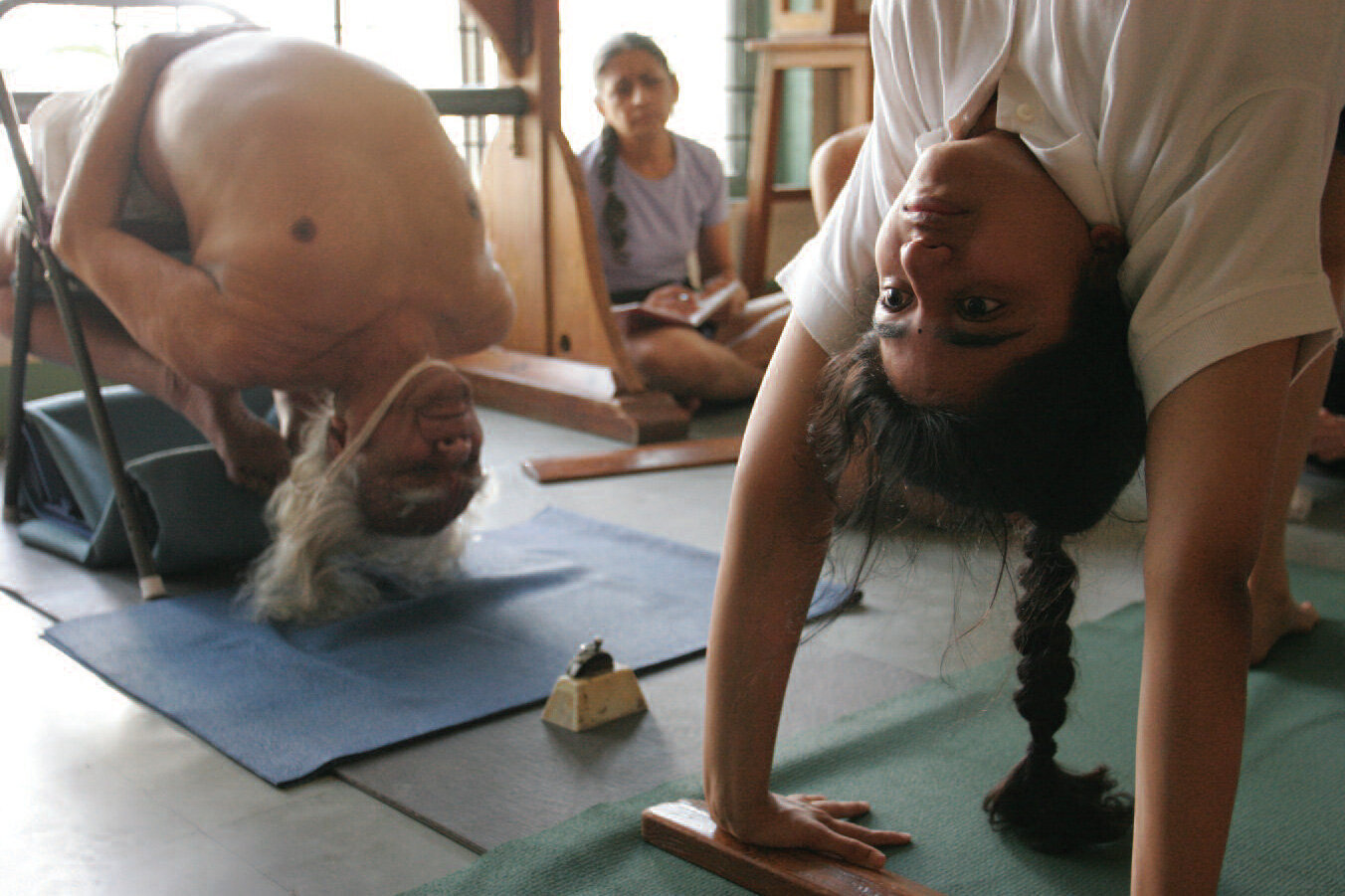
Practice Point #20 - Iyengar Yoga in Turmoil???
What is it like being an Iyengar yoga teacher in a time of such turmoil in the organization? When people have passed away and all the stuff?
I received a question from Seth in the USA. Their question is...
What is it like being an Iyengar yoga teacher in a time of such turmoil in the organization? When people have passed away and all the stuff?
A little background to Seth's question.
BKS Iyengar passed away in 2014 and his daughter one of his successors passed away in 2018. In 2019 the Ramamani Iyengar Memorial Yoga Institute announced a new teacher's assessment model which has not been finalised due to COVID-19.
It is no surprise this question has been asked as many people in the community are perhaps feeling in turmoil or disillusioned.
I don't feel this way. As BKS Iyengar said "It is my profound hope that my end can be your beginning”
I feel hopeful, inspired, and excited by change.
This is my nature though. I thrive on change.
Furthermore, I am a 'young' teacher in the Iyengar community, I was never directly taught by BKS Iyengar and see Abhijata Iyengar as my teacher and look to her for guidance and direction.
She may be young, but she holds her ground, is articulate, and has shown great leadership during this time.
How we respond (react) to the change is a practice of yoga in itself. What is our reaction to telling us about ourselves? What are we gripping to? What are we fixed on?
If you feel disturbed by the changes in the Iyengar system, listen closely to their teachings. There has been a tremendous emphasis on your inner teacher and Svādhyāya.

If you would like to submit a question about home practice and receive the answer in these weekly Practice Points, you can below. Question-related to specific injuries will not be answered.
Practice Point #21 - Hamstring Tightness
Why do cycling and running tighten the hamstrings? How can we counter this tightness without having to stop cycling or running, so that we don't have to compromise on the hamstring flexibility?
I received a question from Neha in India. Their question is...
Why do cycling and running tighten the hamstrings? How can we counter this tightness without having to stop cycling or running, so that we don't have to compromise on the hamstring flexibility?
The million-dollar question for anyone who loves to run and cycle.
This is a two-part question, to answer the first part...
Why do cycling and running tighten the hamstrings?
You can feel this just by standing on both feet, bend one leg up behind you. You will feel the hamstring contract and shorten it. This is essentially what you are doing a thousand times over when you run or cycle.
How can we counter this tightness without having to stop cycling or running, so that we don't have to compromise on the hamstring flexibility?
Find the right balance!
If you run and cycle more than you stretch (do yoga) you are going to be in a never-ending battle with your hamstrings.
Think of a yoyo, you are shortening and then lengthening.
However, if you do more stretching and less shortening you might start to get somewhere:)

If you would like to submit a question about home practice and receive the answer in these weekly Practice Points, you can below. Question-related to specific injuries will not be answered.
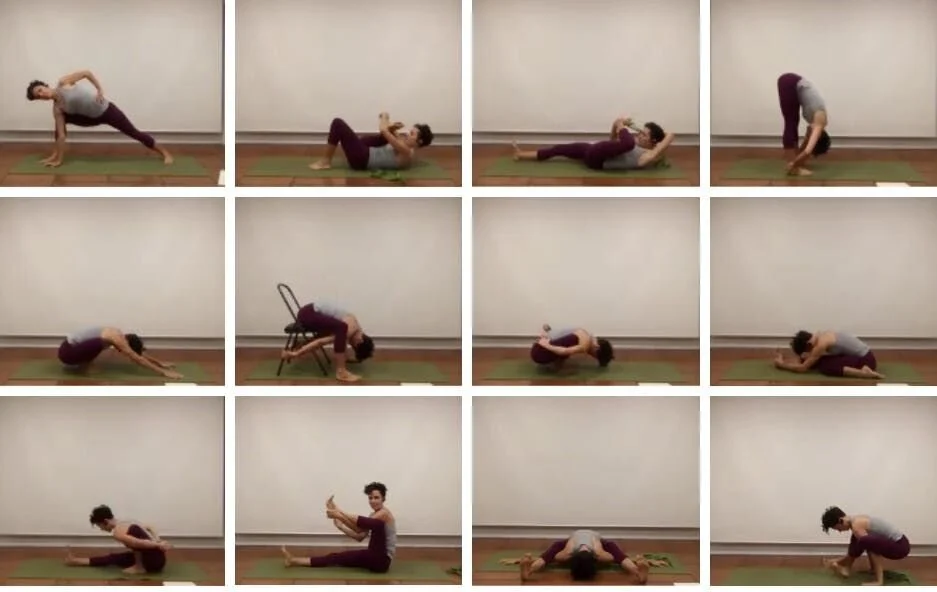
Practice Point #22 - Sequence for Bhujapidasana
Can you show sequence to work on bhujpidasana?
I received a question from Beena in India. Their question is...
Can you show sequence to work on bhujpidasana?
Sure I can. This is a sequence I was working on in my teachers and trainess program.
We were breaking down challenging asana to distill the index pose.
Here is what we came up with.

If you would like to submit a question about home practice and receive the answer in these weekly Practice Points, you can below. Question-related to specific injuries will not be answered.

Practice Point #23 - Timing for Restorative Postures
How long to hold restorative poses?
I received a question from Erma in USA. Their question is...
How long to hold restorative poses?
This will depend on your level of experience and ability.
I think there are a few key factors to help you determine how long you should hold a restorative posture for.
The posture is done to restore the body. If the body is not at ease, comfortable and in a relxed state it can't restore. Come out of the posture when it is no longer comfortable.
Each day the body is different yesterday you may be able to hold Viparita Karani for 20 minutes with ease and today perhaps after 5 minutes agitation comes. Don't force yourself to hold the posture for a long time if the body/mind can't settle. Change posture and try something else you think you will be more comfortable in.
Gradually increase the hold of a posture to build up the duration.
If you are comfortable try holding the posture for 20 minutes to give the body a good chance to completely settle down and restore.

If you would like to submit a question about home practice and receive the answer in these weekly Practice Points, you can below. Question-related to specific injuries will not be answered.
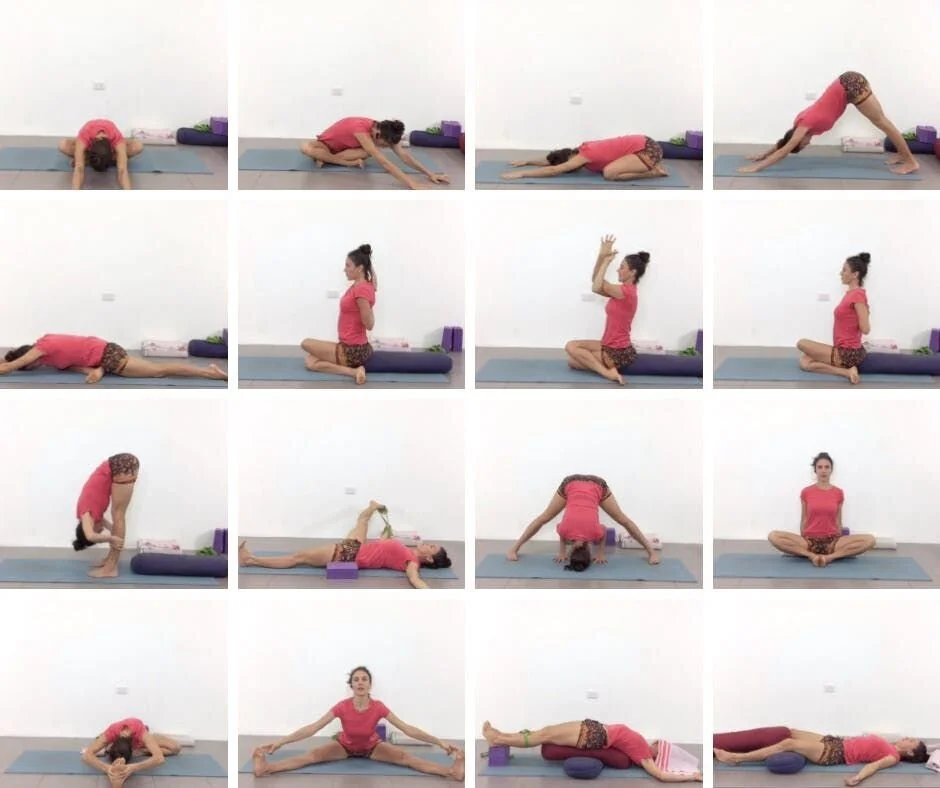
Practice Point #24 - Hip Opening Sequence
Can you suggest a sequence to open the hips, as I want to do paschimottanasana?
I received a question from Neelam in India. Their question is...
Can you suggest a sequence to open the hips, as I want to do paschimottanasana?
Try this simple sequence for opening the hips. Keep in mind that the hamtrings are also a big player in Paschimottanasana and need to be lengthened as well for this asana.

If you would like to submit a question about home practice and receive the answer in these weekly Practice Points, you can below. Question-related to specific injuries will not be answered.
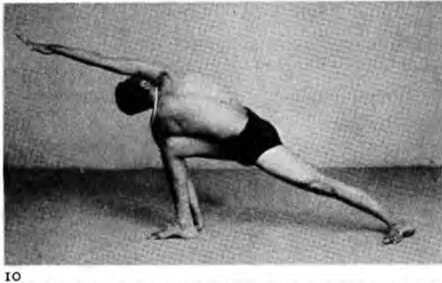
Practice Point #32 - Parivrtta Parsvakonasana Hook
In parivrtta parsvakonasana, how do I bring my right shoulder over the left knee or vice versa? Should the knee be in the crook of the armpit or by the tricep?
I received a question from Sush in India. Their question is...
In parivrtta parsvakonasana, how do i bring my right shoulder over the left knee or vice versa? Should the knee be in the crook of the armpit or by the tricep?
A challenging pose and interesting question, which I am sure many people have.
Yes, we are aiming for the armpit to hook the knee, which you can see clearly demonstrated in Guruji's image in LOY.

Whenever I am in doubt about a posture (often) I always refer to the plates in LOY as a guide. But we have to remember that many things came before Guruji could do this posture in this manner.
So we too have to explore and try different methods before we can hope for the final posture or getting the armpit to knee grip.
Here are a few things I have played with to progress this posture.

If you would like to submit a question about home practice and receive the answer in these weekly Practice Points, you can below. Question-related to specific injuries will not be answered.
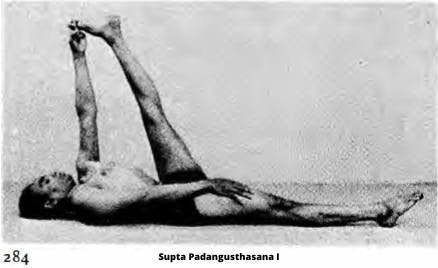
Practice Point #34 - Supta Padangusthasana
Could you explain the most beneficial order for the learning of all of the Supta pandangusthasanas?
I received a question from Ann in USA. Their question is...
Could you explain the most beneficial order for the learning of all of the Supta pandangusthasanas?
There is confusion around the Supta Padangusthasana poses because they have had a name change and the order varies in the various texts.
Supta Padangusthasana I

Supta Padangusthasana II

Supta Padangusthasana III used to be

However, Supta Padangusthasana III is now

If you would like to submit a question about home practice and receive the answer in these weekly Practice Points, you can below. Question-related to specific injuries will not be answered.
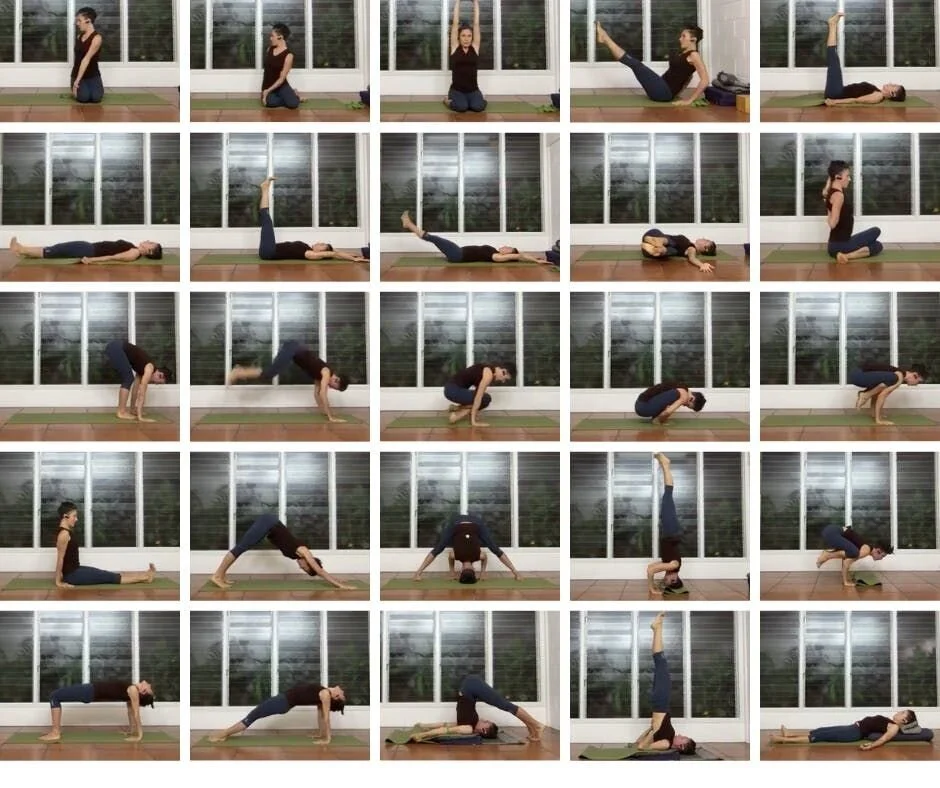
Practice Point #42 - Bakasana
Could you please give a sequence to work on bakasana?
I received a question from Maira in Brazil. Their question is...
Could you please give a sequence to work on bakasana?
Sorry about the image not being very clear for this sequence with the glass window bakcground, but that aside I am sure this will help you on your way to Bakasana.

If you would like to submit a question about home practice and receive the answer in these weekly Practice Points, you can below. Question-related to specific injuries will not be answered.
Practice Point #43 - Hyperextension
I have hyper-extending elbows and knees which means it's very hard for me to get enough grip and presence on my upper arms and thighs to work and stretch them. I find it particularly difficult to lift my thighs properly in standing poses. Having these loose, floppy junctions makes it hard for me to trust my body, which distorts very easily! I wondered if you had any useful tips on how to work those two areas?
I received a question from Anna Cowper-Canaux in France Their question is...
I have hyper-exending elbows and knees which means it's very hard for me to get enough grip and presence on my upper arms and thighs to work and stretch them. I find it particularly difficult to lift my thighs properly in standing poses. Having these loose, floppy junctions makes it hard for me to trust my body, which distorts very easily! I wondered, if you had any useful tips on how to work those two areas?
This is a common problem and I am so glad it has been asked.
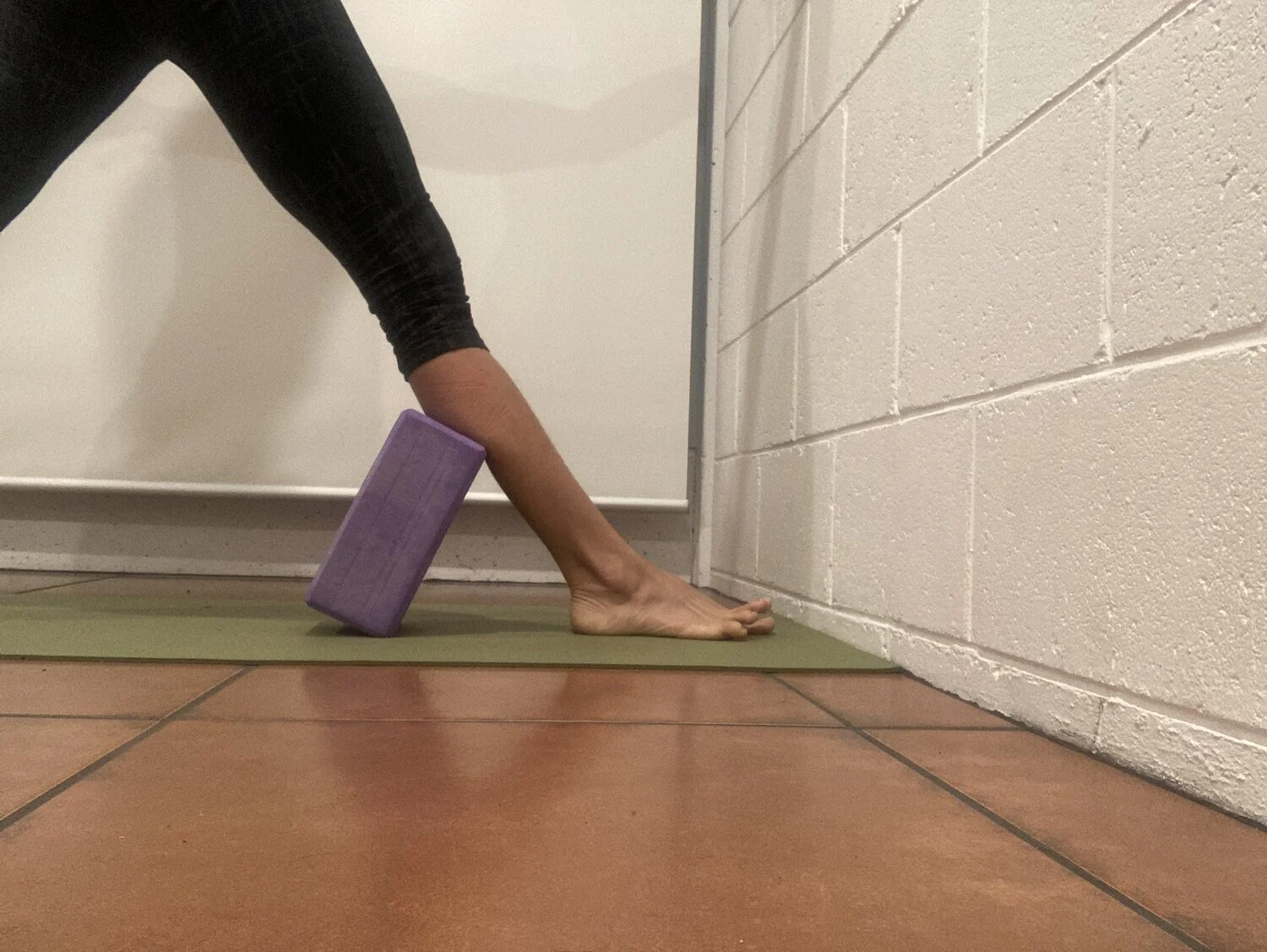
For the legs, I would work with a brick under the calf placed at an angle as shown in the picture. This will stop you from pushing the knee back and hyper extending and will allow you the opportunity to properly engage the vastus medialis oblique muscle which is found above the right inner kneecap.
You need to learn to pull this muscle up to grip the thigh. After time and practice you will be able to remove the brick and engage this muscle. When this muscle works well you will no longer push the knee and hyper extend.

As for the elbows. I depends on the pose, but if we look at Adho Mukha Svanasana I would try either a below around the elbows and pressing the outer elbows to the belt or a block elbow on the inner elbows.
Either can work it depends on the body, try both and see what works for you.

If you would like to submit a question about home practice and receive the answer in these weekly Practice Points, you can below. Question-related to specific injuries will not be answered.
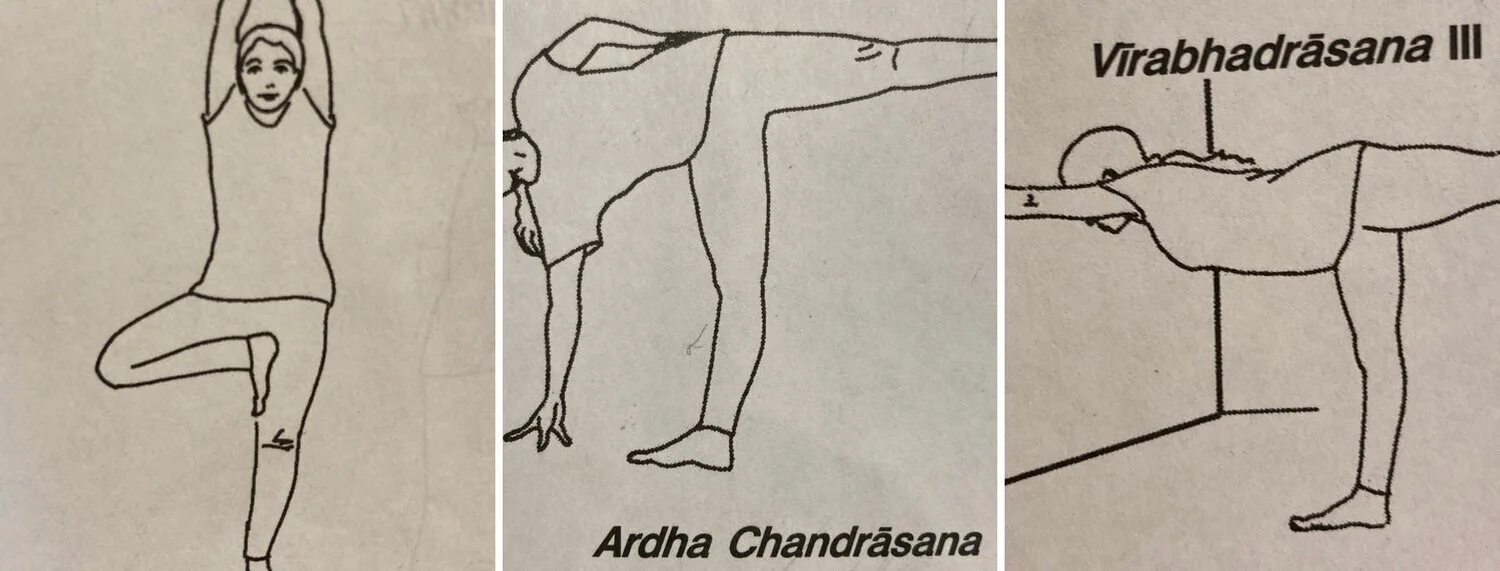
Practice Point #45 - Balance and Core
I tried paddle boarding and found balancing very difficult, what can I practice in my yoga to improve my balance? I am a beginner student.
I received a question from Helen in United Kingdom. Their question is...
I tried paddle boarding and found balancing very difficult, what can I practice in my yoga to improve my balance? I am a beginner student.
Balance and core strength go hand in hand.
It's a bit of the chicken and the egg question. Which comes first?
If you include in your daily practice some standing balancing postures and basic abdominal postures, I am sure you will notice a difference in your paddle boarding.
Observe your pelvic abdominal region when you are doing the balancing postures, notice the subtle core engagement that is required.
Try including these postures in your daily practice.


Good luck and please report back on your progress.
If you would like to submit a question about home practice and receive the answer in these weekly Practice Points, you can below. Question-related to specific injuries will not be answered.
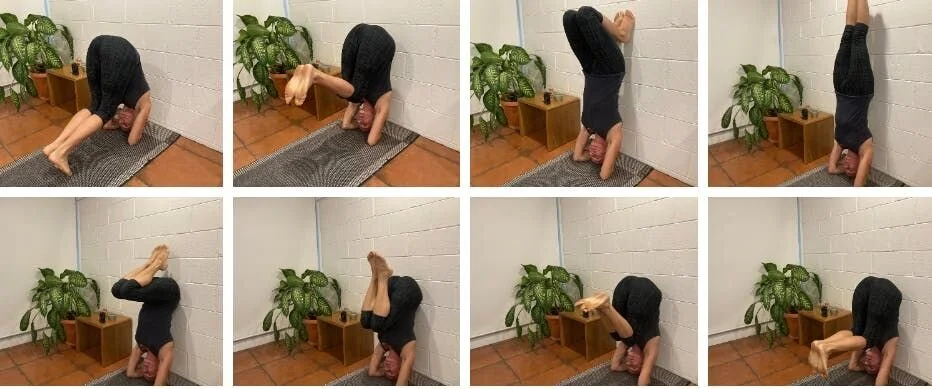
Practice Point #47 - Sirsasana
I am able to do sirsasana against a wall by throwing one leg up and then bringing the second leg up. I would like to progress by actually taking both legs up together in a controlled way?
I received a question from Monika in USA. Their question is...
I am able to do sirsasana against a wall by throwing one leg up and then bringing second leg up. I would like to progress by actually taking both legs up together in a controlled way?
Taking both legs up at the same time requires a great deal of core and back strength.
I have two strategies for you to practice.
Start with practicing coming down with both legs together and straight.
Practicing coming up with both legs together but bent.
The image below demonstrates coming up and down with the legs bent and together.

If you would like to submit a question about home practice and receive the answer in these weekly Practice Points, you can below. Question-related to specific injuries will not be answered.

Practice Point #50 - Other Styles of Yoga
Is it possible to practice different styles of yoga and be an Iyengar yoga teacher?
I received a question from Seth in the USA. Their question is...
Is it possible to practice different styles of yoga and be an Iyengar yoga teacher?
In short, NO!
When you are a certified Iyengar yoga teacher and promoting Iyengar yoga as what you teach, you are not allowed to mix styles.
It would be very difficult to practice in a range of different styles of yoga and not be influenced and as a result, mix them.
Practicing, and teaching one style keep it closer to the source.
Having said that, what defines Iyengar yoga?
Iyengar yoga is not static. It is an evolving practice. Those who practice and teach it are responsible for the continuation of it.
In my practice I often do things that I have not been taught by another style, nor have I been taught them by an Iyengar teacher, they are simply creative expressions within my practice, that I may or may not share with students.
It comes down to integrity and the teachers' practice of Satya.

If you would like to submit a question about home practice and receive the answer in these weekly Practice Points, you can below. Question-related to specific injuries will not be answered.